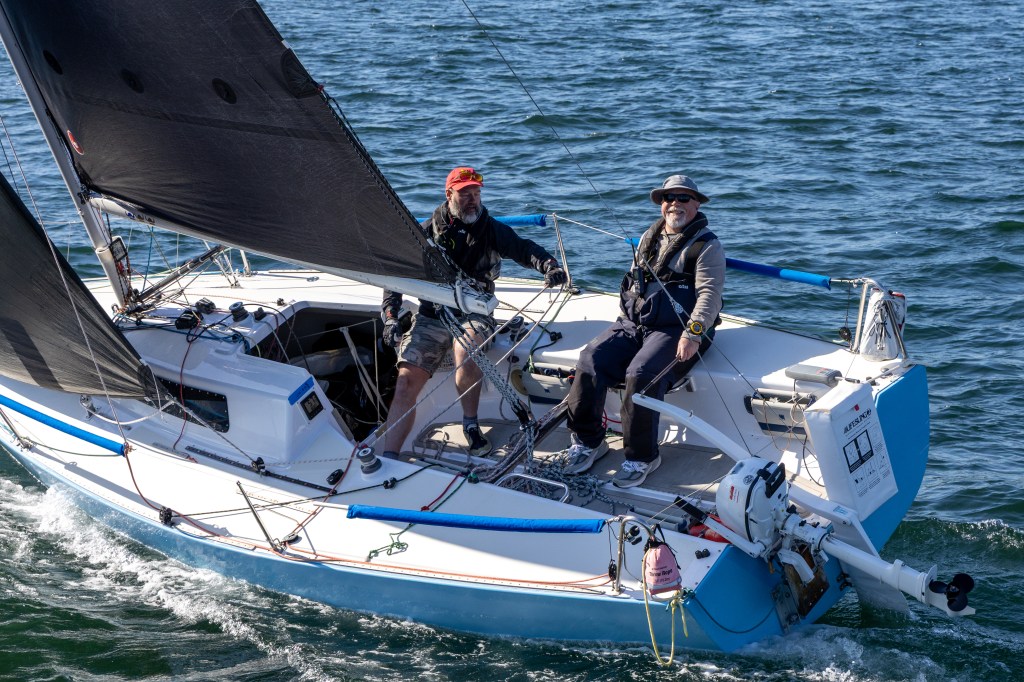
Close your eyes and ask yourself: what is your vision of the perfect race? Sunshine? Check. Warm weather? Check. Good breeze? Check. This year’s Race to the Straits ticked every box for two days of spectacular sailing.
Saturday morning started brilliantly, with a fickle light breeze tempting more than 100 boats to say, “Go ahead. Put up the light #1.” We all knew better. We all knew the wind was going to build. The forecast had been remarkably consistent: 15 to 20 knots from the north all day long. But there we were on the start line, full of hope, flying the big #1 jib. Unfortunately, optimism and salt water seldom mix well.
A Physics Lesson
We got off the start line cleanly and headed north up the Sound toward Kingston. The wind, as promised, built quickly from a tame 10 to 12 knots into a much livelier 15 to 18. In the grand scheme of sailing, that is not outrageous, but when you are double-handing, that is the moment when a pleasant morning sail quietly changes into a workout. The tide was ebbing, the wind was against it, and a decent chop began to build. Soon we were bashing into waves, with spray everywhere. Around Cherry Point, we were getting overpowered enough that we switched from the #1 to the #2. Not long after that, we tucked a reef into the main.
It is all just simple physics. The force on the sails increases dramatically with wind strength. Double the wind speed and you roughly quadruple the force. Suddenly, simple maneuvers like tacking become much harder, especially when there are only two of you on board. Everything takes a winch. The boat is heeled over hard, so moving around is work all by itself. And visibility? Forget about it. Sitting on the windward rail driving the boat, you struggle to see boats crossing below your sails. Mostly, you see your own sail and a generous helping of sea spray. To check for traffic, you either perform a yoga-like forward bend to peer under the boom every few minutes, or you send your crew down to look for you. None of this is impossible, but it does require work, coordination, and attention at exactly the moment when you are under pressure and getting tired. Maybe you skip one look because there was no traffic the last time you checked.
And that is when it happens. You hear a shout from beneath the sail: “Starboard!” You look down and there is a boat bearing down on you. You have about two seconds to assess the situation. Are you going to hit them? What are you going to do to avoid them? It is brutal how fast that decision has to happen. If you hesitate for even a second, you may not have enough time. And remember that little physics problem? The pressure on the sail plan is so great that the boat becomes very hard to control. You cannot simply turn away from trouble unless sheets are eased or sails are adjusted. The wind will just pin you down on the same course. Turning the rudder by itself does almost nothing.
We had one very close call that we avoided with a crash tack. It was close enough that we needed a moment afterward to collect ourselves before continuing with the race. As it turns out, we were not the only ones dealing with that problem. With more than 100 boats racing on the Sound, plenty of boats met each other on crossing tacks. Most handled it cleanly. Some did not. Unfortunately, there were multiple collisions on Saturday. The physics was relentless and uncompromising.
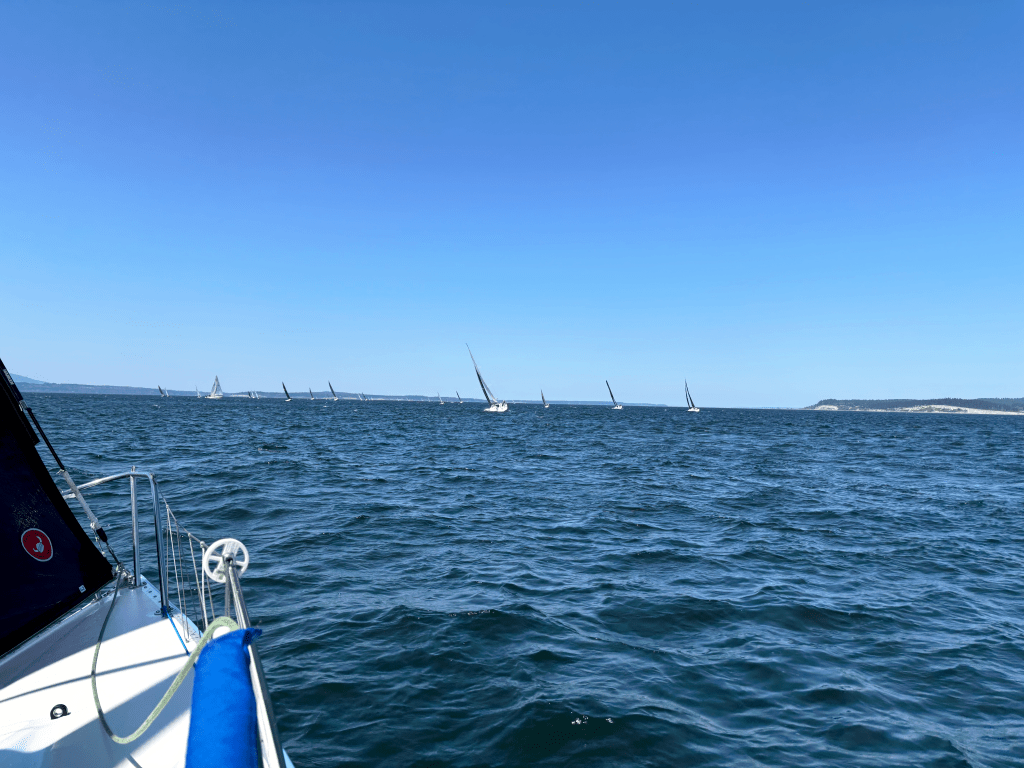
All the way up to Point No Point, the breeze held steady around 15 to 20 knots. We rounded the Double Bluff buoy around 1:00, just as the tide was getting ready to change. Up to that point, we had been helped along by the ebb. Now the tide turned against us as we continued up Admiralty Inlet. We crossed the inlet to the west side and began working our way up the Marrowstone shoreline, short-tacking to stay out of the worst of the current. The wind moderated a bit, settling somewhere around 10 knots with regular puffs to 15, but it was still challenging sailing because each puff seemed to arrive with a 30-degree wind shift tucked inside it. Finding a groove was nearly impossible. One minute everything was cruising along just fine. The next, we were heeled over hard and pinching to stay upright. Rinse and repeat all the way up the inlet.
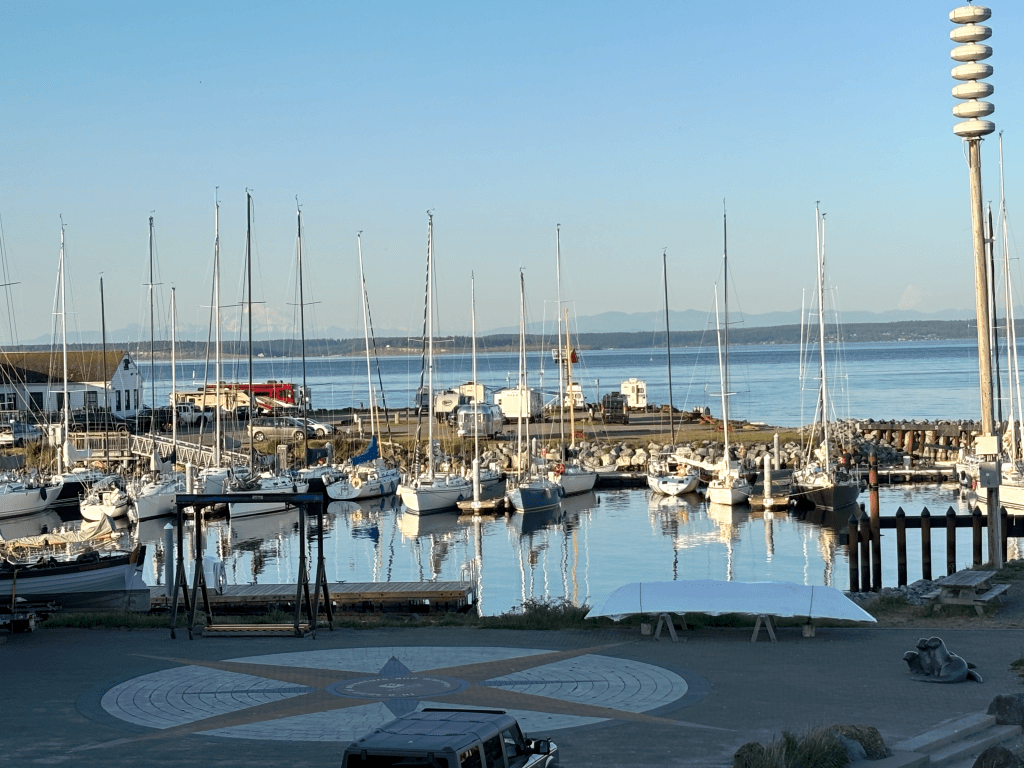
We rounded Marrowstone Point around 3:30 with the finish line in sight. From there, we crossed the bay toward Port Townsend with the sun sparkling on flat water and the Olympic Mountains rising in the background. It was a ridiculously beautiful finish, the kind of scene that makes you forget, at least briefly, that your knees hurt and your hands have turned into cracked leather. We crossed the line around 4:30, taking 8th in our class. Afterward, we socialized a bit at the party, wolfed down some excellent barbecue, and then went straight to bed. After a long day in the sun and breeze, I was dehydrated, sore, and completely wiped out.
Ibuprofen Sunday
We woke the next morning to more sunshine and a lovely northerly breeze around 10 knots. It was delightful right up until I had to move. My whole body was sore. The Jane Fonda Double-Handed Sailing Workout had worked its dark magic. I managed to coax my creaky frame down to the coffee shop and begin the careful process of resuscitation required to become minimally functional again. Eventually, we got Blur out on the bay and prepared for what looked like a spectacular downwind run back to Seattle.
When our start time arrived, we put up the chute and flew toward Marrowstone Point. The tide was ebbing, so we were not entirely sure whether we would make it around the point against the current. When we got there, though, we found just enough breeze to round the corner and start heading south. Once again, we had to work the shoreline to avoid 3 to 4 knots of current. Looking back, we could see the entire fleet of more than 100 boats behind us, every one of them with spinnakers up. It was stunning: a full-on sailboat migration, with colorful chutes spread across the Sound.
We gybed our way down the bluffs and finally crossed back toward Double Bluff around 11:00. The current was still stiff, but it had eased enough that we made it over toward Mystery Bay in decent time. Unfortunately, we got unlucky and sailed straight into a windless hole. By the time the breeze returned, we had lost touch with our class. But the wind filled in again, and soon we were sailing toward Point No Point. It got fickle for a while, then finally settled into a steady 15 knots. With just two of us on board, Blur picked up her skirts and skipped down the waves along the Kingston shoreline.
We crossed back toward Shilshole around Jefferson Point and held a very hot angle all the way to the finish. We came screaming in at about 10 knots, with a rooster tail flying behind us. How we managed to do it without broaching, I will never know. But there we were, heeled over hard, chute up, blasting toward the line like we had stolen the boat. We crossed the finish around 4:00. I believe we were 7th in our class for the day.
Windburned and thoroughly used up, we folded sails and put the boat away. It may have been the best weather we have ever had for Race to the Straits: two days of sun, breeze, salt spray, sore muscles, and the kind of sailing that reminds you why you keep coming back.


Leave a Reply