Day Three of Grand Prix kicked off with a wonderful preview of winter. I rolled into the marina at 8:30 AM and was immediately greeted by a wall of cold rain. The traveler had come apart at the end of Day Two, so before coffee or common sense could intervene, I was elbows-deep in repairs. By the time the crew arrived at 9:30, I was soaked through my foulies, through my layers, through the tiny part of my soul that was still warm. A delightful start.
We shoved off around 10, and although the forecast had promised a mellow day, Nature had a different plan. We motored out to find a shifty 10–12 knots pumping in from the east. Not exactly the gentle conditions we were told we’d enjoy.
Race One: Drag Racing Practice
The first race was twice around. We nailed the start, right on the line at the gun, and managed to hang with the fleet all the way to the top mark. From there, things got weird. With the wind out of the east, both legs turned into reaches, so it was less tactical finesse and more straight-line horsepower. Blur is scrappy, but against the big sleds in a drag race, that’s a tall order. We held our own, but the race committee wisely decided the course needed a little adjustment.
Race Two: Now We’re Talking
For the second race, we punched out another competitive start and rounded the weather mark comfortably in the mix.
Then the fun hit.
A 20-knot squall rolled in from behind like it had a grudge. Suddenly Blur was on the step, touching 10 knots and rolling past bigger boats like we actually belonged there. It was glorious chaos. We made the leeward mark, executed one classic broach for style points, got the chute down, and powered upwind in 18–20 knots to the finish.
Sixth place. Our best finish of the regatta. Spirits went from soggy to soaring in about three boat lengths.
A Crew to Brag About
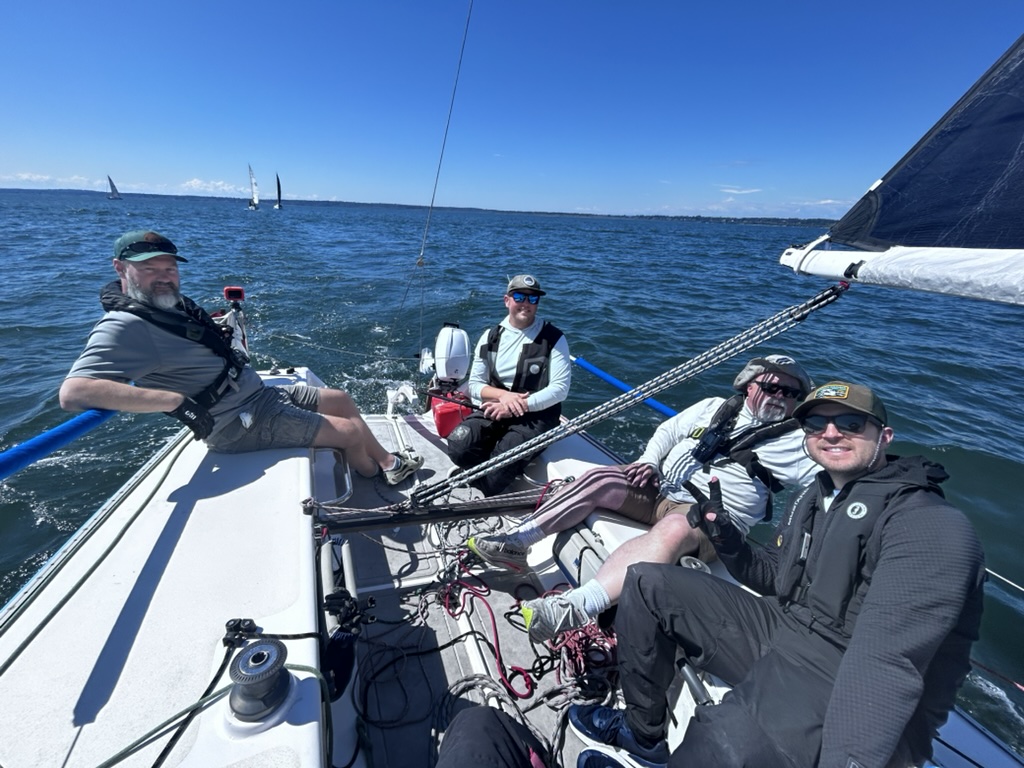
Same crew as Day Two. Same zero experience with Blur. Same unfamiliarity with each other. Yet this wild, last-minute collection of sailors absolutely gelled. Nobody panicked, everyone pulled their weight, and it just worked. I could not have asked for a better group.
The Grand Finale
By the time we got back to the dock, everyone was soaked, freezing, and thrilled. Blur got tucked into bed, we got cold beers into hands, and then it was off to the Seattle Yacht Club for the traditional Grand Prix bash. The party alone is worth entering this regatta. Great food, great people. Exactly why this event is such a highlight.
The Results
Our class was stacked with talent. TC took first, Sabotage claimed second, and Madame Pele rounded out the podium. Nine boats total, all tough competitors. More than one person mentioned how cool it was to see a small boat like Blur out there fighting for it. I’ll happily take that compliment.
End of Season
Grand Prix is the finale for us. Blur will dry out for a while, and I’ll spend the winter hitchhiking rides on other people’s boats. Come spring, we’ll wake her up, shake her out, and get ready to rumble again.
Thursday’s race was a pursuit format—a fun twist where each boat gets its own start time based on handicap ratings, so in theory, everyone finishes at the same time. It’s a great way to mix boats of all shapes and speeds into a single race. The course? A 20-nautical-mile tour starting in the harbor, heading south to Eliza Island, then a loop around Vendovi Island and Viti Rocks—clockwise or counterclockwise—before racing back to the harbor.
The twist? You choose your direction around the islands. And we had no idea which was better.
With zero local knowledge and no secrets whispered by old salts, we were left to squint at current charts, poke at weather apps, and make our best guess. We settled on counter-clockwise.
Cue the flashback to Indiana Jones and the Last Crusade. You remember the scene: the villain picks the wrong grail and turns to dust, and the knight solemnly declares, “He chose… poorly.”
Well, my friends, so did we.
The day started off beautifully. Wind in the 16–20 knot range, reefed main, number two headsail, and we were absolutely flying upwind toward the islands. It was glorious. And then… it wasn’t.
We picked the wrong direction. The current slapped us in the face. We tacked and fought and drifted and cursed our way around the rocks. A slow-motion cascade of small, compounding errors—nothing dramatic, just death by a thousand tactical paper cuts. By the time we emerged from our navigational misadventure, we had managed to drop to last place.
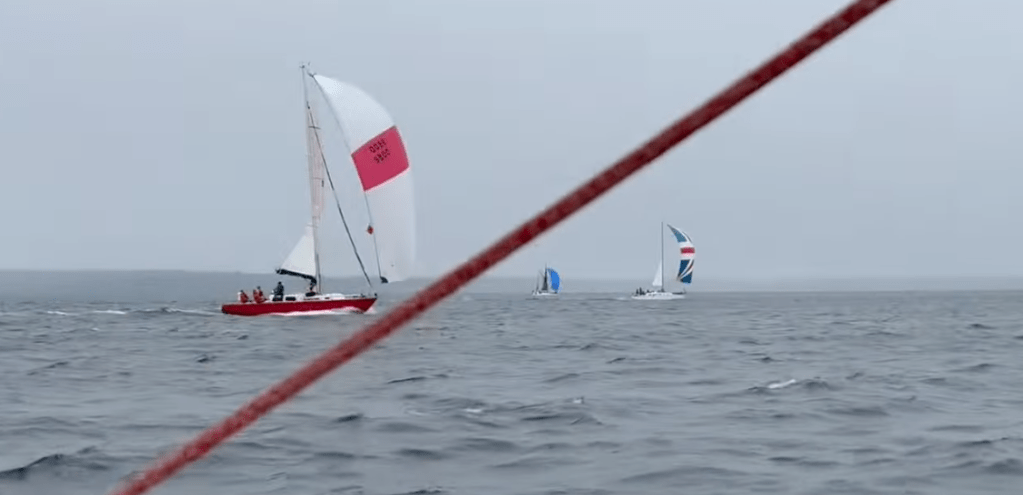
The ride home was long, quiet, and humbling. We hoisted the chute and flew downwind toward the finish with a mix of resignation and reflection. Somehow, we clung to third place overall in our class—but just barely.
Every sailor knows this truth: some days, you just get humbled. Thursday was our turn. But despite the tactical trainwreck, the conditions were stunning, the wind was exhilarating, and Bellingham once again served up a spectacular day on the water.
So, this is the inaugural year for Race Week in Bellingham, and let me say—on paper, it has everything going for it. Quaint college town? Check. Great food? Yep. Beautiful scenery? Absolutely—snowcapped peaks, sparkling water, and just enough boutique charm to make you think, Hey, maybe I could live here.
But wait, there’s a “but.”
Turns out Bellingham has a little Tuesday night ritual downtown called street cleaning. Sounds innocent enough, until you learn that it involves tow trucks prowling the streets like apex predators at 2:30 AM, mercilessly dragging away any car foolish enough to be asleep at the curb. That’s right—two of our crew cars, including mine, were spirited off into the night like a bad subplot in a city planning thriller.
By the time we paid the ransom (err, towing fee) and reclaimed our vehicles from the automotive gulag, Tuesday had already earned a special place in my personal hall of infamy. I was tired, grumpy, and under-caffeinated—basically the ideal mindset for high-stakes racing.
Still, we made it to the course on time, and Blur was back on the water. That said, Day Two didn’t live up to the fairy tale that was Monday. Our starts were… let’s say “interpretive.” Either we were late, out of position, or just jumped the gun entirely. Not exactly textbook form. The silver lining? Blur is still faster than regret, so we clawed our way around the course pretty well—just not well enough.
We slid a few places over the course of three races—mostly fourths and fifths—and while the boat was performing, the humans were clearly stuck in second gear. The weather, at least, was playing nice: fog in the morning, followed by sunshine, 8 to 10 knots of breeze, and a start line that looked more like a demolition derby than a sailboat race. If Monday was aggressive, Tuesday was full-contact. The protest room was doing brisk business by the end of the day, which tells you everything you need to know.
On a tactical note, the racecourse started to shift—slightly less of the standard “bang the left corner” strategy. We found a few gains sneaking to the right on the upwind legs, and by mid-afternoon, the fleet was fanning out like someone had kicked over a box of toothpicks. Not chaos—just a little more nuance.
We did manage to squeak out a third in the final race, which felt like a moral victory considering the sleep deficit and mild existential crisis from earlier.
Back at the marina, the post-race theme was Christmas in July—because nothing says “sailing regatta” like fake snow, tacky sweaters, and rum drinks in Santa mugs. Cheers to that.
After the pavilion festivities, we wandered into town and blew off a little steam.
If I ever had to introduce someone to the sport of sailing, Day 1 of Bellingham Race Week would’ve been the perfect way to do it.
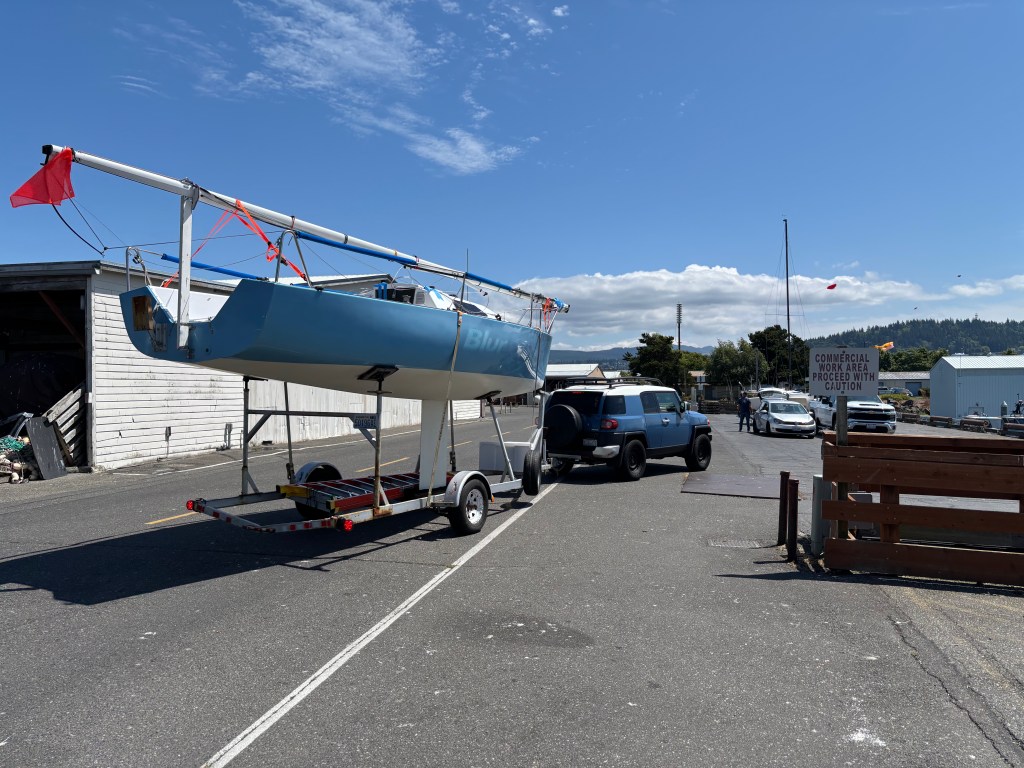
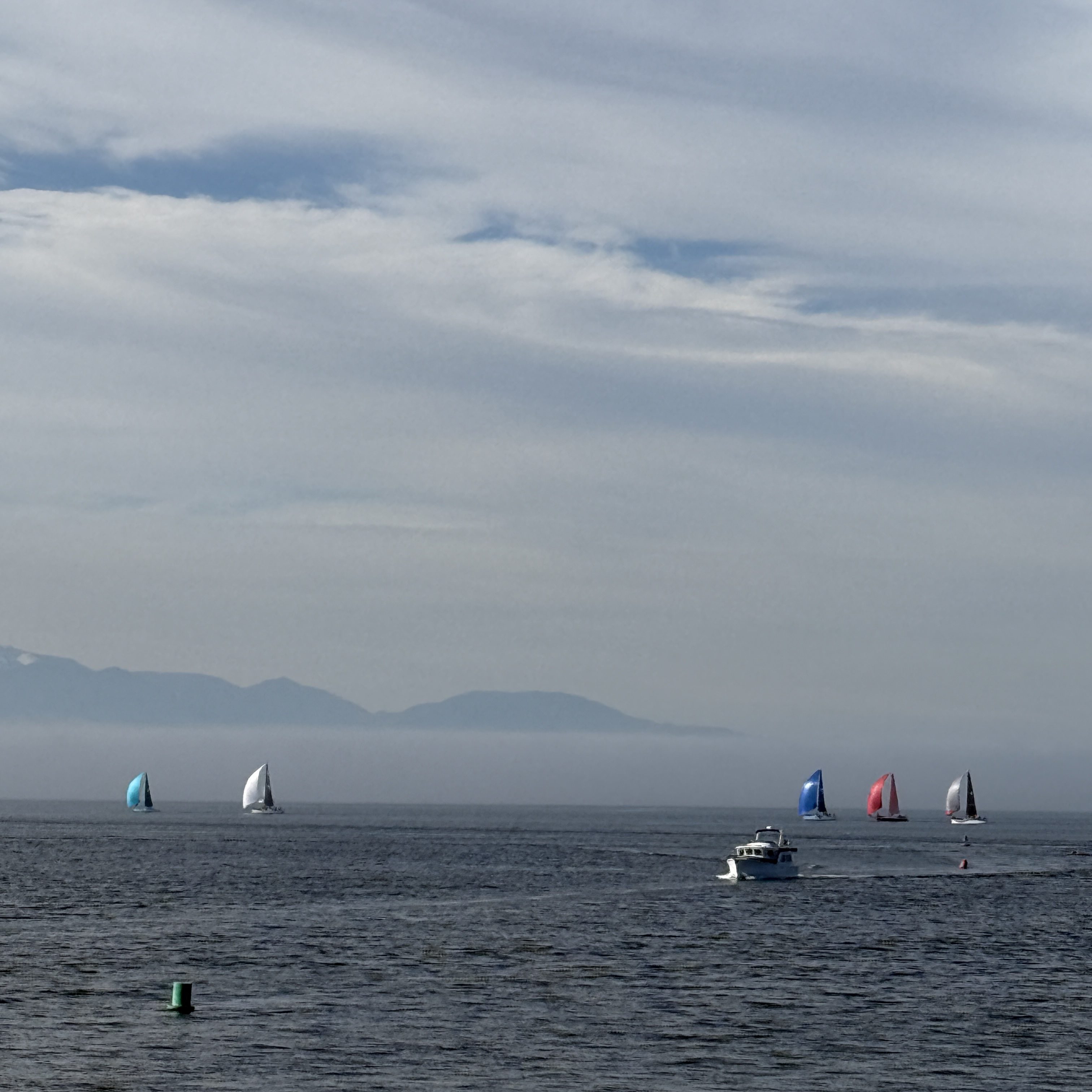
We trailered the boat up from Shilshole on Sunday, got her rigged, splashed, and tucked into the harbor. The weather? Absolutely stunning—70 degrees, sunshine, snow-capped mountains on the horizon, and of course, Bellingham Bay. Couldn’t have asked for a better welcome.
The Racing
We had a guest tactician, Alex Simanis from Ballard Sails, on the boat for the day and it really showed in our performance. He played boat whisperer and helped us up our game across the board. From improving the rig tuning to fine tuning the sail trim, he did an amazing job.
Our first race of the day started after a short delay. We’re sailing in the PHRF B division, so we got to watch all the other classes start before us—so we had front row seats. The big ORC boats, the sleek J/105s and J/80s, the nimble J/70s, and the Melges 15s all made for some exciting starts and tight action.
I’ll admit it: starts are my favorite part of racing. Maybe I’ve got a tiny adrenaline junkie buried in there somewhere, but the chaos, the yelling, the jostling for position—it’s electric. And when you nail it? When you pop out on the line with clean air and good speed? For just a second, you feel like a rockstar.
That first race, we sailed clean and fast and came in third in our class. Not a bad way to start the week.
Wind and Tactics
The breeze in the morning was steady—around 13 to 15 knots—which gradually tapered off as the day went on. The course setup heavily favored the left side of the bay, so most of the fleet bee-lined it toward Fairhaven, hit the weather mark, then gybed their way back down to leeward. Tactically, it was pretty locked in—go left, or get left behind.
Then in race two, we found our groove, hit our shifts, and brought home our first bullet of the week. Race three, we got another third. By the end of the day, we were sitting in second place overall in Class 7—easily one of our best performances to date. I was over the moon.
After the Racing
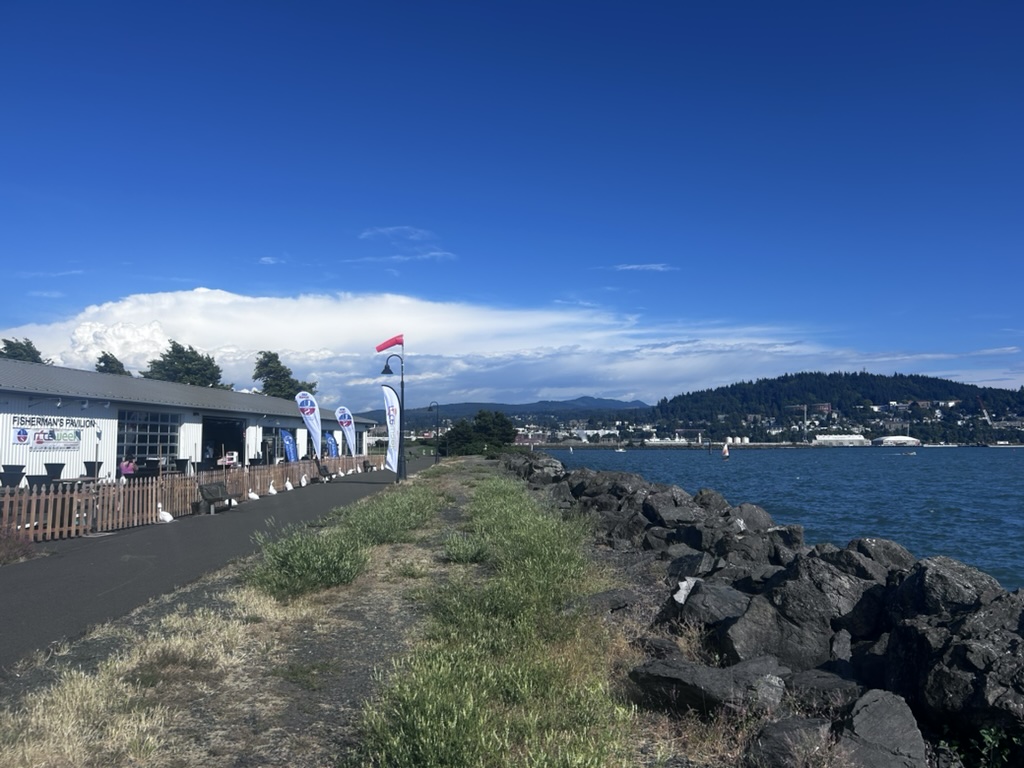
After a full day on the water, we wrapped things up at the race pavilion with beer, music, and the usual suspects. It was great to reconnect with old friends, swap stories, and soak up the atmosphere. Nothing quite beats tired bodies, sunburned smiles, and a good result on the scoreboard.
It’s the morning after the Possession Point Race and I think my whole body is sore. I’m covered in bruises across my arms, legs and ego. In short, it was a punishing race.
Just like last year, it started off mild enough to fool most of us into going out and giving it a try. The sound was flat with a tame 10-12 knots coming out of the south east. There were occasional 15-16 knot puffs rolling through, but nothing menacing. It was a lovely downwind start and Blur jumped to a quick lead in our class. We soon discovered that those puffs I mentioned each came with a fairly significant wind shift hidden in them. This caused the boat to roll pretty strongly. We took it in stride, but driving and trimming was quickly becoming a full concentration job. I couldn’t take my eyes off the sails for even a second for fear of a puff hitting us and rolling us into a gybe to windward. The breeze steadily increased as we moved north (just like @#$^%$ last year) and soon we were surfing down big rollers at an average of 12 knots (that’s twice Blur’s hull speed boys and girls). In short: we were screaming along.
We jump to an early lead
The wind had now picked up to about 17-18 knots with occasional puffs up around 23-24. We decided to play cautious and waited for a lull before we gybed around the Richmond Beach area and headed back out toward the middle of the sound. At this point we found it was just LXVII, us and I think Aurora in the lead of our class. It was around this time that we heard the Person(s) Overboard incident down near Edmonds. Apparently 2 people were in the water. A group of the fast boats was responding (Freya, Smoke, etc.) as well as the Edmonds ferry boat. It was a scary incident because it seemed like it took a while to retrieve them. We monitored the VHF, but were too far away to render assistance. In the meantime, the wind had picked up further and was now firmly around 23-24 knots with occasional puffs to 30. We were hitting top speeds easily around 15 knots as we surfed down the ever increasing rollers. We moved everyone to the back of the boat in an effort to keep things stable.
Blur’s Wild Ride
At around 12 knots of boat speed, Blur starts to make a humming noise. The whole boat starts to sing. We call it Blur’s happy noise. I don’t know where it comes from. Most likely from the rigging and the backstay. It starts almost subliminally and you feel it in your bones. Blur was singing all the way from Richmond Beach down to the Possession Point Buoy. We made down there in 90 minutes flat.
The good news was, that I was having no difficulty driving and keeping the boat on its feet. The bad news? With the emergency in progress and the big rollers, I no longer felt confident gybing in those conditions. When Blur gets into a 3-5 chop, gybing our big masthead symmetrical chute becomes pretty dicey. I didn’t want to lose anyone overboard so I called for a douse and we pulled the chute down and gybed over to point back toward Possession Point. I’d like to note that Blur was the smallest and lightest boat in the race (25 ft, 2000 lbs). We get knocked about in the big seas a bit worse than many of the bigger, heavier boats. So, everyone on Blur wears life jackets all the time. Before we had left the dock, we even rigged jack lines and our foredeck crew were wearing (and using) a safety tether. At the dock I remember thinking, “Maybe, I’m over-preparing, it doesn’t really look that bad…” and as we were screaming down the rollers North of Edmonds, bow submerging in the waves, I was thinking, “Thank GOD we rigged the jack lines!”
It turns out we had some challenges getting the chute back up: re-rigging after the gybe was a mess. But we finally got it back up and were once more flying toward our halfway mark. We rounded up once or twice, just to keep everyone on their toes. The puffs were strong as hell and kept trying to spin us out. But we surfed and fought our way down to the bell buoy.
The Upwind Slog
Rather than feeling a sense of accomplishment, I was feeling a sense of dread: now we had to go back upwind and against the current. It was going to be a slow, hard slog home. We doused the chute and rounded the mark and there were already signs of chaos: Some boats were already motoring back, some had torn headsails. All of the TP52s had retired. Yikes!
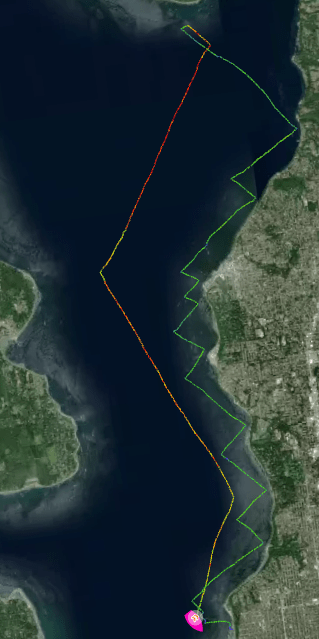
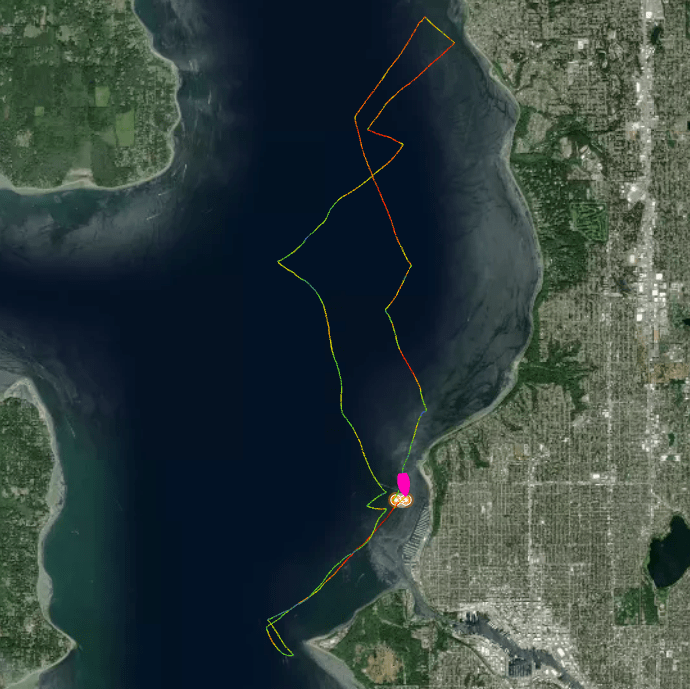
Our course for the race
First thing we did was tack over toward the Edmonds shore. Jesus, what a meat grinder that was! 25 knots gusting to 30. 3 foot waves with the occasional 5 foot beast mixed in. I’ll describe it in one word: yuck. We had brand new upwind sails courtesy of our friends at Ballard Sails. But we must have spent the first 20 minutes of that ride just re-learning how to trim for the conditions. We were on our ear most of the way. Blur was heeled over so hard that I had to hook one arm over the lifeline and steer with the other in order not to fall across the boat. We put a reef in the main, and that helped a little bit. At one point, we got slammed with a particularly vicious 30 knot gust and we were blown completely on our side. The mast was close to parallel with the water. I’m quite sure our keel was out of the water. Suddenly, I had this gut feeling that we were right on the cusp of Blur’s “point of diminishing stability.” We were now literally dragging sideways downwind in the water.
I did not like it. Not one bit.
We were completely pancaked on our side and not bouncing back up. I was convinced that if we didn’t do something fast we ran the very real risk of rolling the boat. I recall yelling at the jib trimmer to blow the jib sheet (the main was already blown). They blew the sheet and the boat promptly stood back up with water cascading from the rigging (phew). Yelling was the only way to communicate at this point over the howling of the wind and the flogging of the sails. To say that we struggled in these conditions is to abuse the wrong adjective. We survived. Perhaps I shouldn’t be so dramatic, but that’s how it felt at the time. In retrospect, my Vakaros instrument says we only heeled over 45 degrees. What a dumb instrument.
The boat was constantly trying to round up or alternately lie down on her side. Driving was a freaking nightmare. I couldn’t find a stable groove to save my soul. We’re up. We’re down. And we’re up again. The tiller had taken on a life of its own and was making a concerted effort to wrench itself from my grasp. We were wildly overpowered. Nevertheless, through trial and error we made some modest progress upwind and kept with the fleet. We briefly considered switching from the #3 to the extra small #4 headsail, but at the time we decided not to because the rough conditions made a sail change seem like a good way for someone to get hurt or fall overboard.
There were two things that kept me going at this point. First, after abandoning last year’s Possession Point race, I really wanted to finish this one. Heavy upwind air is my nemesis on Blur, and I wanted myself and the crew to learn how to manage big air if possible. Second, I had a set of brand new sails. Although I hated to flog them (Ouch! Ouch! Ouch!), I also felt very confident that they were the best possible sails for the conditions. My old, blown-out sails would have made things even worse. So in the back of my mind, my mantra was “Hang in there, it’ll get better.” Sure enough, that’s exactly what happened. As we got up to Edmonds the wind died down a bit to roughly 12-15 knots and we were given a small reprieve. We were able to work on trimming the sails and we could relax and just sail the boat for a good 30 minutes or so. We even shook the reef out. However, in the immortal words of Hagrid the giant, “I probably shouldn’t have done that…”
What it looks like when the driver takes a dive…
Just about the point where we were starting to think, “Hey, this isn’t so bad.” The wind decided to pick up again. F*ck (that’s pirate-speak for “I really wish that hadn’t happened”). The new breeze settled into a pattern of 15-17 knot lulls with 22-23 knot puffs. Not the worst conditions in the world by any means, but not easy going either. At this point, I slipped while driving a puff and took a bad fall across the cockpit. I think I might have caught air. I ended up lying on my back on top of the tiller, all four hooves in the air, and the boat immediately spun a circle. Grouchy and bruised, I got us back on track. Unfortunately, I repeated that performance 2 more times (without the spinout) as we worked our way back upwind. I really need to put some seatbelts in the driver’s station on Blur. I got the sh!t kicked out of me. The crew was starting to worry, “Dude, you OK?” The problem was that the boat was still getting heeled over hard in the puffs and the deck was slippery as snot. If I didn’t have an arm wrapped around the lifelines, I was more than likely going to get tossed around. I watched a big J/boat go powering past us with the skipper standing blithely and proudly at the helm station, seemingly without a care in the world, and I’m pretty sure I called him a few dirty names.
Sorry dude.
We kept that up all the way to the finish. There really isn’t much more to tell. At that point, everyone was exhausted. Me and the crew had started to form some pretty strong opinions about how to trim the sails in heavy air (I guess that’s the learning part) and we were all fairly cooked. So we did some rather average upwind sailing back to the finish and called it a day. We came in fourth in our class and I think 19th overall, so I’m pretty happy with that result. Satisfied? No, we can do better, but I’ll save that for next race.
We got back into the dock at Shilshole and that’s when I completely “bonked”. Yep, I hit the wall like bug hits a windshield. 5 hours of driving in those conditions and I was completely wasted. I was massively dehydrated and hadn’t eaten for the entire trip. Honestly, letting that happen was kind of stupid on my part. It was such a white knuckle ride for the entire race that I never even considered eating or drinking. I’d need a third hand to do it anyway, because I almost always had one arm wrapped around the lifeline and one on the tiller. Still, a power bar in my pocket would have been a good idea. I was driving like a zombie toward the end of the race. How do zombies drive you ask? Quite poorly.
Lessons Learned
Overall, this race was almost a repeat of last year’s race conditions minus the big 50+ knot squall. We got away lucky with regard to damage: 1 broken cabin house window and we lost one winch handle overboard.
Key learnings:
The #3 jib is good from about 14 knots up to 18-20. Above 20 knots we start getting overpowered very quickly. We can hold the #3 in about 23-24 if we use a lot of twist, but only for short periods with lots of feathering at the helm. Now that I have a #4 to work with (using a #4 is a new concept for me) I think I’ll try using it starting around 20 knots and see how that works. I’m actually REALLY curious now.
The new main is a dream, but it’s powerful as hell. It’s easy to keep flat, but if it’s even a little out of trim I can’t get a good groove at the helm. I might actually have to start talking to the main trimmer…
30 knots is really starting to look like our bail out number. Between the sea state and the small size of our boat, that’s fast becoming the point where I confidently say, “Screw it. We’re done. Let’s pack up and seek shelter.” I’m glad we did this race. We pushed ourselves a bit and stayed safe. But we’re also on a small boat and there is always an upper limit. I won’t even go out if it’s already blowing 20-25 before I even start.
Eat and Drink. Yes, even the skipper. Fail to do so and you will get stupid. Don’t get stupid.
Congratulations to the other boats in our class who all finished including:
LXVIII
Aurora
Cherokee
Blur
Mata Hari
Bardo
Mara
I owe my crew, Brian, Julia and Jeremy a great deal of thanks. They were the secret ingredient that made the day great. I’m kind of hoping that next year it’s a little lighter. It’s hard to find crew this hardcore.
When I got down to the marina Saturday morning around 8 o’clock for the start of the Three Tree Point race the marina was completely fogged in. It was pretty thick – you couldn’t see the breakwater from the dock. There wasn’t but a breath of wind either. Everyone had seen the forecasts and knew that it was going to be a light air day. The race committee made it clear that they were going to postpone the race until the fog lifted. So with that in mind, we went ahead and put the boat in the water and got it all rigged up at the dock. The postponement flag was put up at the clubhouse. Then we did what sailors do when there is no breeze: we all hung out, gossiped, drank coffee, and waited. It wasn’t until 1 o’clock in the afternoon that we finally left the dock. There was still a fair amount of fog out on the sound, but enough had burned off to at least get some sort of racing started. There was a nine hour time limit so the race committee knew they weren’t going to manage to send us all the way down to Three Tree Point and back before dark. So instead, they set a somewhat shorter course for us to run: down to West Point, then up to a mark near Pt. Wells (Edmonds), and back to finish at Shilshole. Still a fairly decent distance, but somewhat shorter than the original race course.
Out on the sound the wind was coming out of the north at about 8 knots. It was supposed to be a fairly warm day, but it was still pretty chilly once we got out on the water. I would estimate that with the windchill it was in the mid 40’s and the dwindling fog didn’t help one bit. The start was in reverse order with the big boats going first and we were to be in the very last start (PHRF Division 8). it was nearly 2 o’clock by the time we got started. The start was down wind. We set the chute and off we flew.
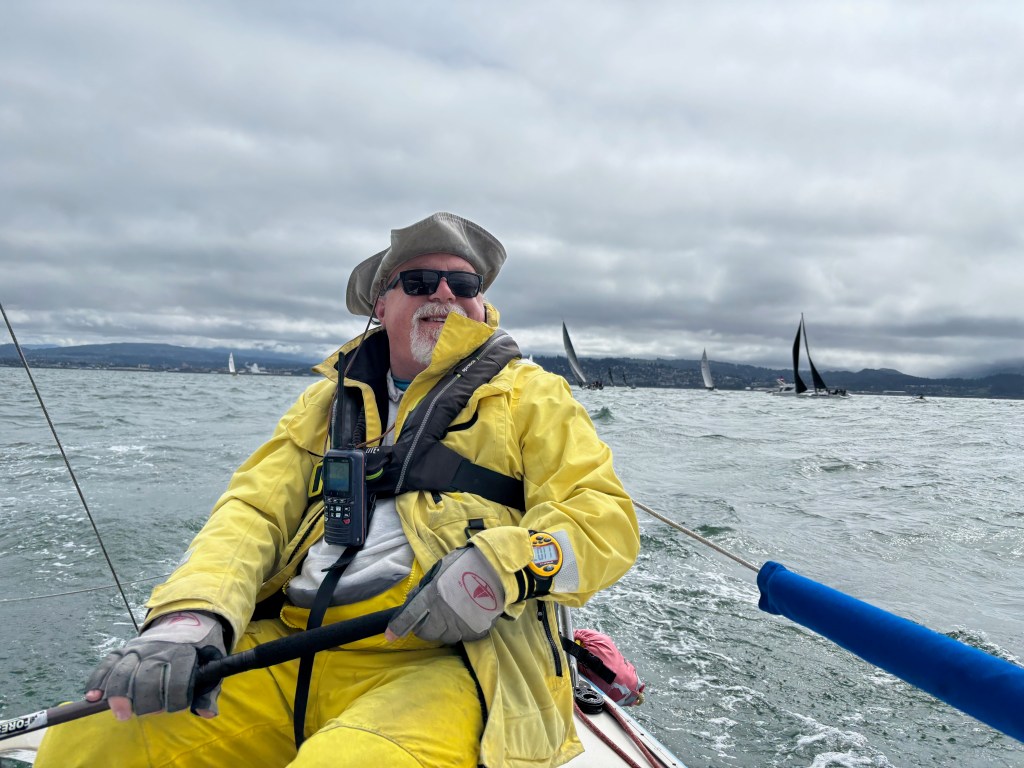
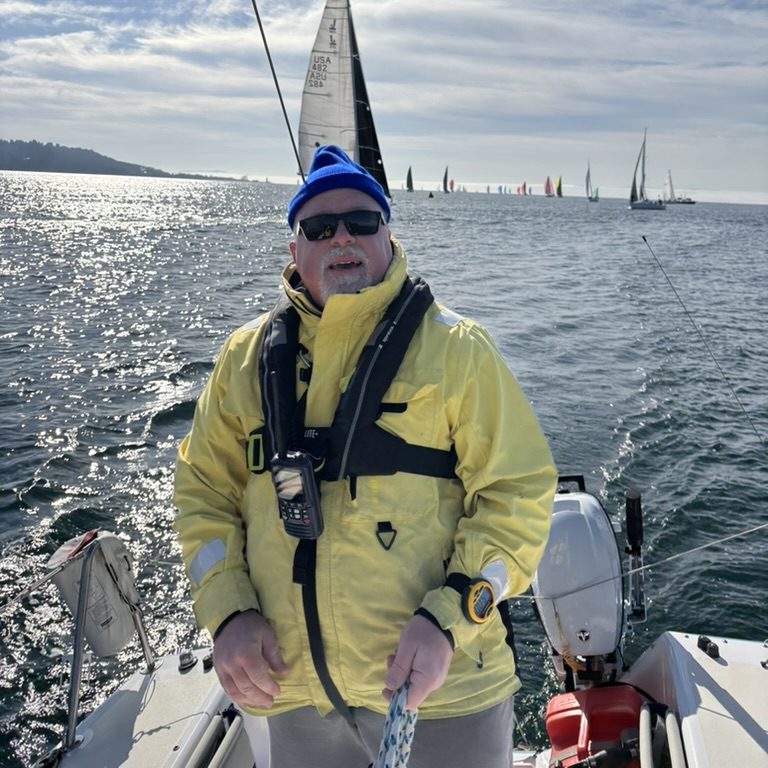
I make Yellow Look Good
We crossed the start line in 3rd just behind LXVII and Aurora. Both of them were to windward of us. We were too close to LXVII to sneak past them to leeward, so we took a hitch to windward and crossed their stern. We accelerated nicely as we did so and caught up to them. We ended up in the same position with Aurora, so we pulled the same maneuver again. And again, we sped up and sailed right over top of Aurora. Now we were leading the fleet down to the mark. The breeze was light, alternating between patches of 4 to 7 knots. Our course to the first mark at West Point was direct. We were keeping it simple, just aiming right at the mark, no jibing, no tricks. Just straight line speed. Aurora, LXVII and Blur were all in a line and we led for most of the way to the mark. However, the breeze got lighter as we got closer to the mark and LXVII managed to get lucky and sneak in ahead of us to round the mark first. We gybed and rounded second with Aurora following close behind. Strategically we could have hugged the shore a bit closer (like LXVII) and gotten a little bit more current push. But it was hard because we had done that little skipping maneuver and put ourselves on the right hand side of the fleet. So it goes.
Our Course for the Race
After we rounded West Point, we put up our brand new carbon fiber #1 and we took a short hitch toward shore and then tacked back out. We went a little ways out toward the middle of the sound and then tacked again back toward Shilshole. The wind in the middle didn’t look too promising. In hindsight, we sailed the exact reciprocal course of our downwind run. So now we were going upwind toward the committee boat and the start line. We spent some time fooling with the jib trim. The new jib is much larger than our old jib, so car placement is much further back. Once we had it dialed in, we found that we were sailing powered up and pointing higher than most other boats in the fleet. We were outpointing boats left and right. J/80’s, J/105’s, it seemed like nobody could touch us. That said, it was still tricky sailing because the wind was fickle, somewhere around 3-4 knots.
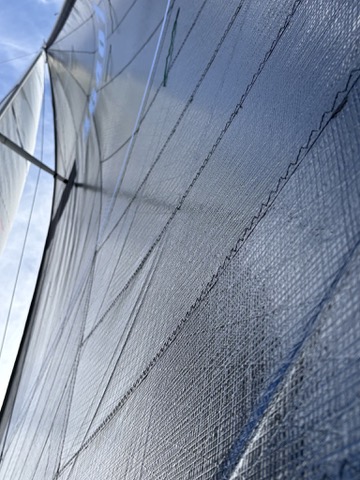
The fancy new #1
As we sailed up toward the start line, we overtook a lot of boats. We lost sight of LXVII and Aurora (along with the rest of our class). By the time we reached the committee boat, we were ahead of a lot of folks. We had to take a small hitch to avoid crossing the finish line, and then we tacked toward Bainbridge Island.
We had a LONG way to go to make it to our windward mark up in Edmonds. So we stayed on that starboard tack for quite a while. Still pointing super high, still making good speed. The anemometer was reading 4 knots of wind speed and the boat speed was reading 4.5 at times! I’m going to have to get those instruments calibrated. But suffice it to say that we were moving quite fast in light air. As we moved northward we passed the J/80 fleet, and soon we were two classes ahead up in the J/105 fleet. I was completely blown away. Our progress was amazing!
As we worked our way northward I think we got strategically lucky. We basically stayed in the middle of the sound and avoided the temptation to hug the eastern shore. We were fighting a flood tide, so it was a bit painful, but we were making steady progress and the wind never completely died on us. I think many of the boats that went in toward the shore got stuck in a wind hole and were hosed. We managed to keep moving steadily and we made a minimal number of tacks, so we kept our speed up. We finally got headed pretty hard and tacked over toward Edmonds.
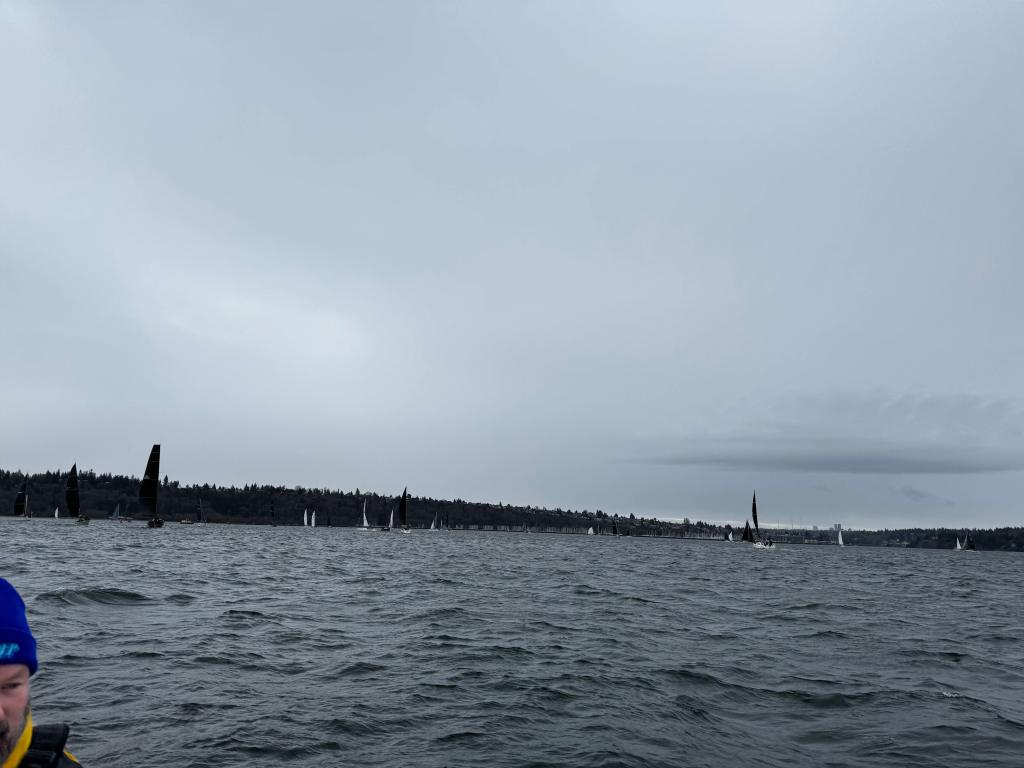
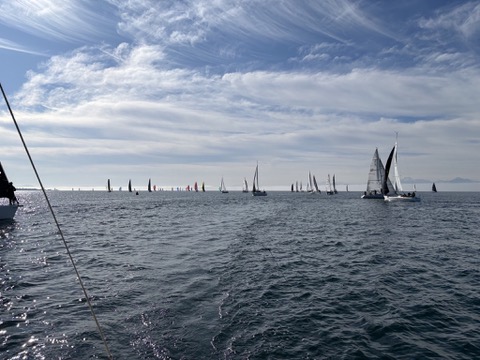
The fleet from ashore
As we came back toward Edmonds it was clear we had made out on the fleet. We were ahead of many of the J/105’s and many much faster/larger boats. It was getting late in the day at this point. Maybe around 4:30 or so. Many boats started to retire from the race. We hung in there and I think we rounded the windward mark around 5:30. Now we had a very long downwind run to the finish line. My concern at this point was that the wind would die off as the sun set (which it often does in the evening). Everyone on the boat was getting cold and tired. The wind alternated between about 8-9 knots and 4 knots. As it got darker the wind got more fickle. It was getting harder and harder to see the wind on the water (what little wind there was). We came dangerously close to getting becalmed as we got back down to Meadow point (just before the finish line). A lot of larger boats were sailing past us. It was really frustrating. We hung in there and managed to catch a passing zephyr and ghost our way across the finish line. As we approached the finish it was pitch dark, and we had no idea who else had finished before us. Cold, tired, and really needing to pee, we docked the boat back at the marina – totally unsure of how we had placed.
We packed the boat up and put her away for the night, and then I went into the clubhouse to say “Hi” to the other folks who had finished. I learned shortly thereafter that we had come in first place in our division, and second overall! To say that I was stunned with the result is an understatement. We had finished that evening completely convinced that we were somewhere back in the middle of the pack. We had lost all sight of the competition and figured that they were all ahead of us. It turns out, they had all gone home.
We owe a big thanks to Ben at Ballard Sails for building a wicked good headsail. We could do no wrong with that headsail upwind. The crew work was nearly flawless. If we keep this up Blur is going to get a reputation as a light air giant killer…which will take a little getting used to.
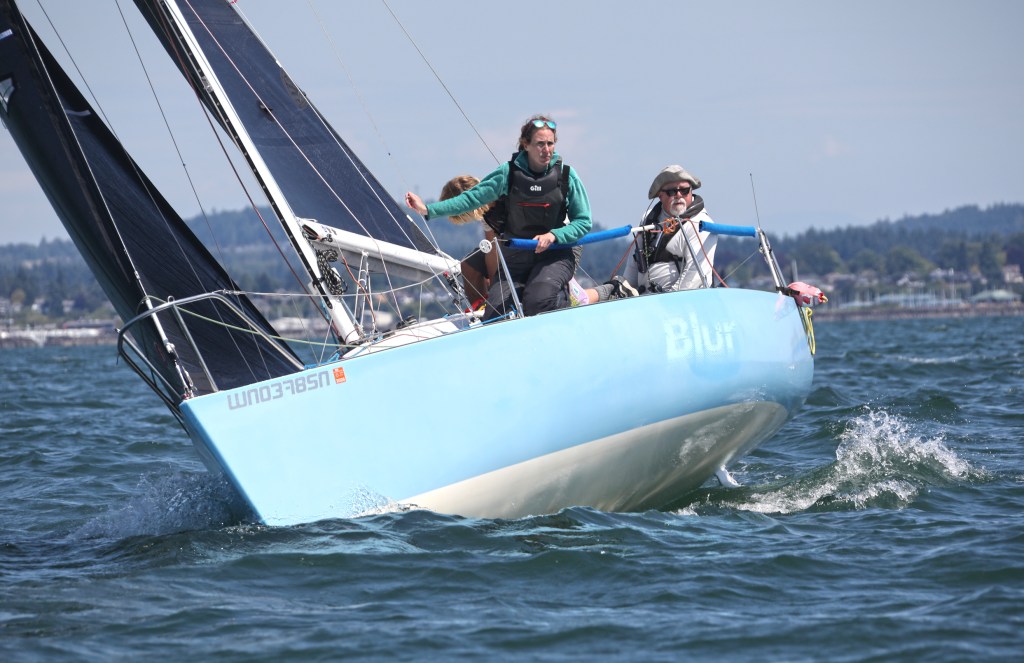
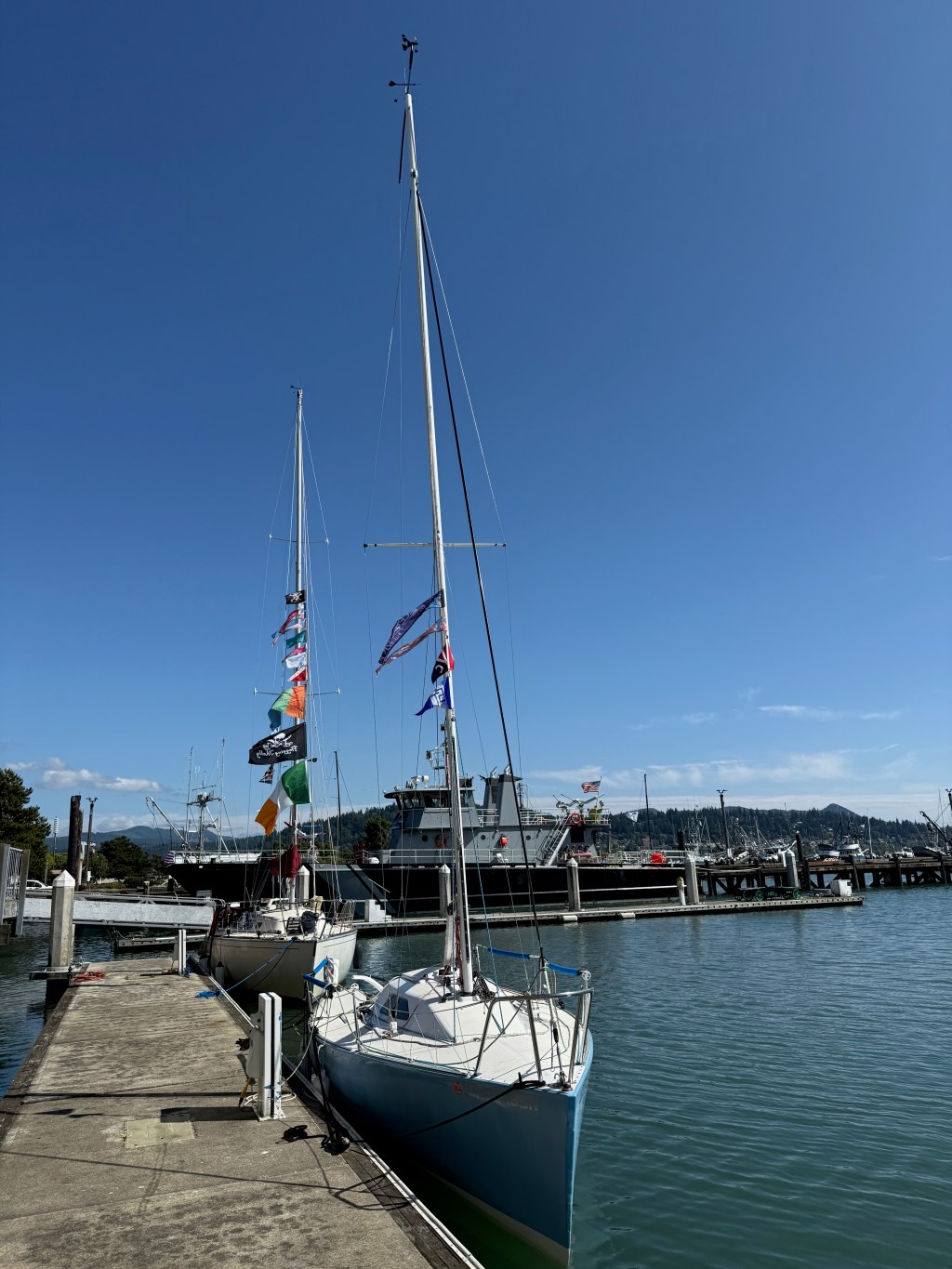
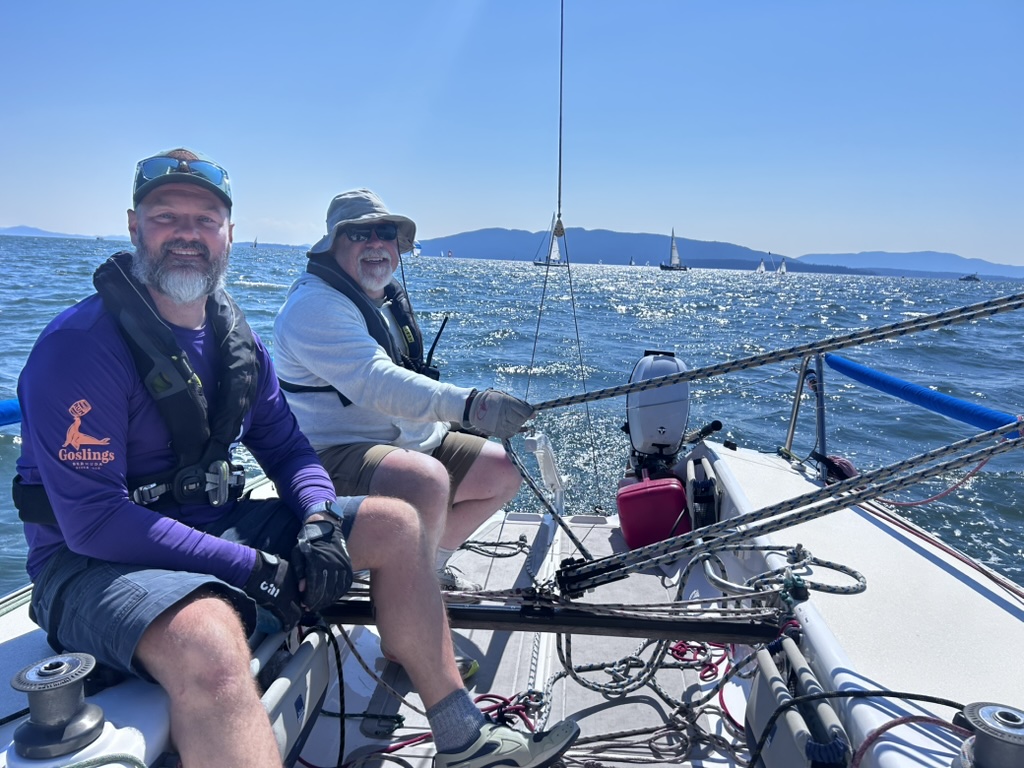


 Blur Racing