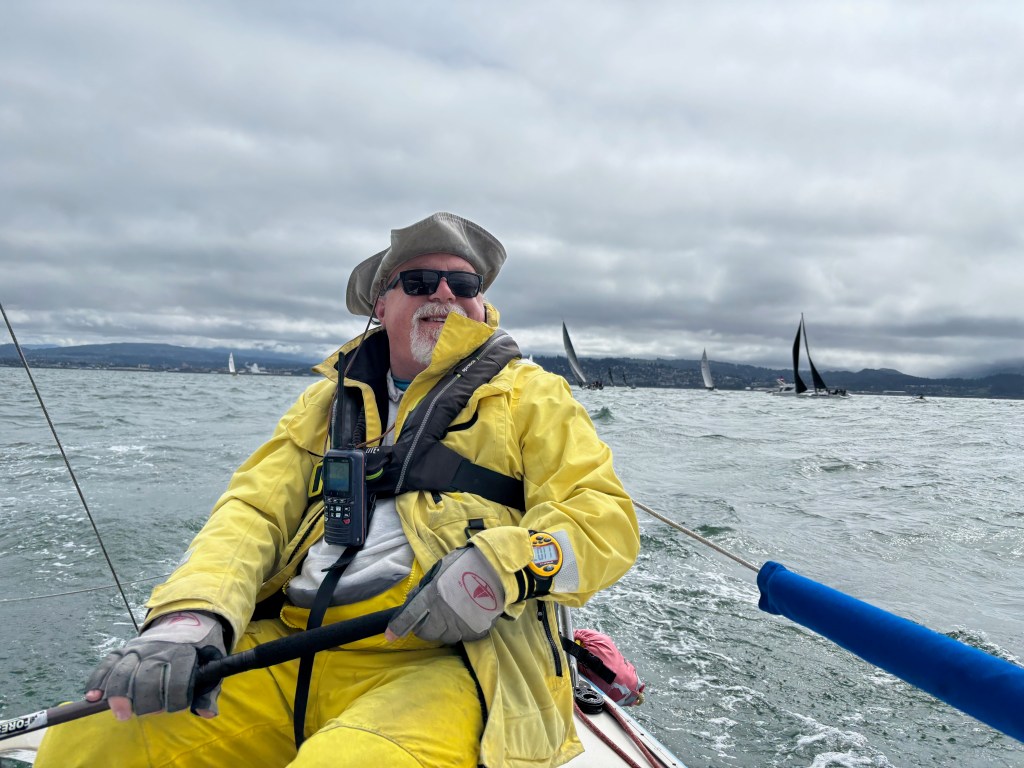
Day Three of Grand Prix kicked off with a wonderful preview of winter. I rolled into the marina at 8:30 AM and was immediately greeted by a wall of cold rain. The traveler had come apart at the end of Day Two, so before coffee or common sense could intervene, I was elbows-deep in repairs. By the time the crew arrived at 9:30, I was soaked through my foulies, through my layers, through the tiny part of my soul that was still warm. A delightful start.
We shoved off around 10, and although the forecast had promised a mellow day, Nature had a different plan. We motored out to find a shifty 10–12 knots pumping in from the east. Not exactly the gentle conditions we were told we’d enjoy.
Race One: Drag Racing Practice
The first race was twice around. We nailed the start, right on the line at the gun, and managed to hang with the fleet all the way to the top mark. From there, things got weird. With the wind out of the east, both legs turned into reaches, so it was less tactical finesse and more straight-line horsepower. Blur is scrappy, but against the big sleds in a drag race, that’s a tall order. We held our own, but the race committee wisely decided the course needed a little adjustment.
Race Two: Now We’re Talking
For the second race, we punched out another competitive start and rounded the weather mark comfortably in the mix.
Then the fun hit.
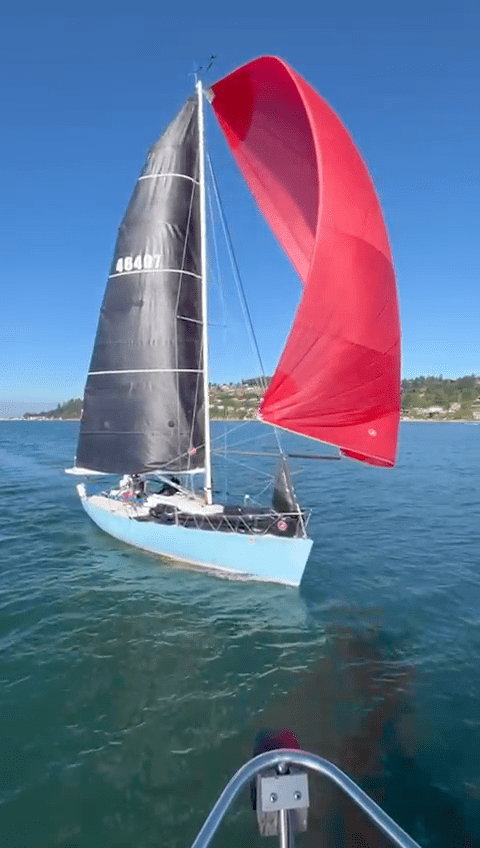
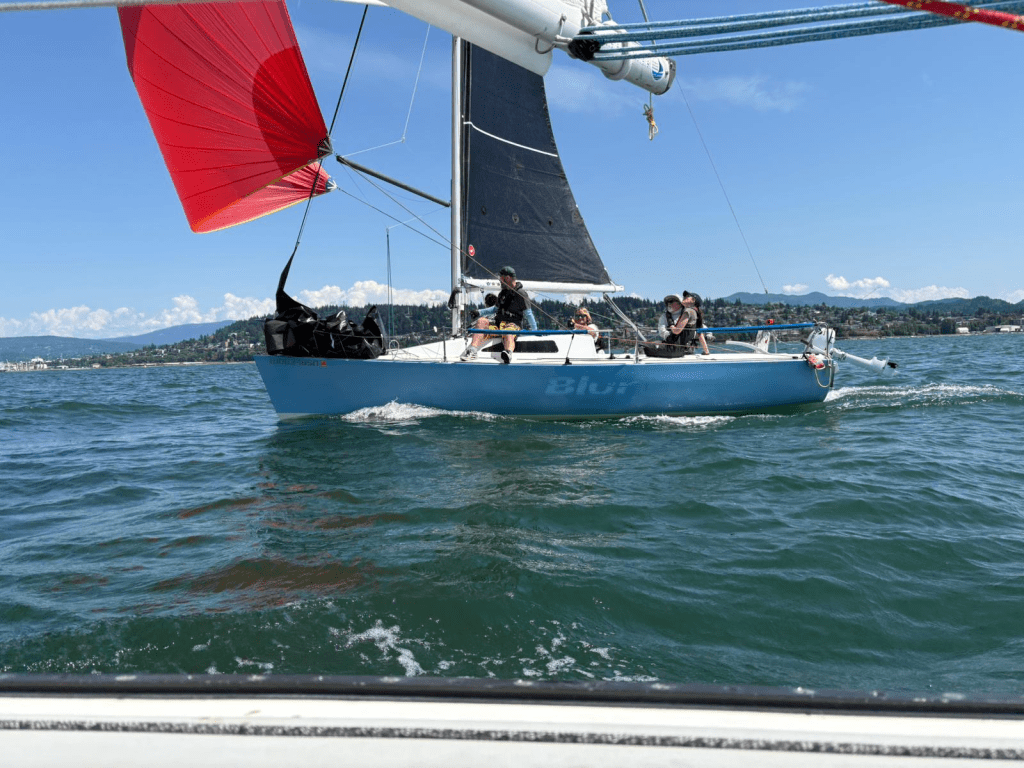
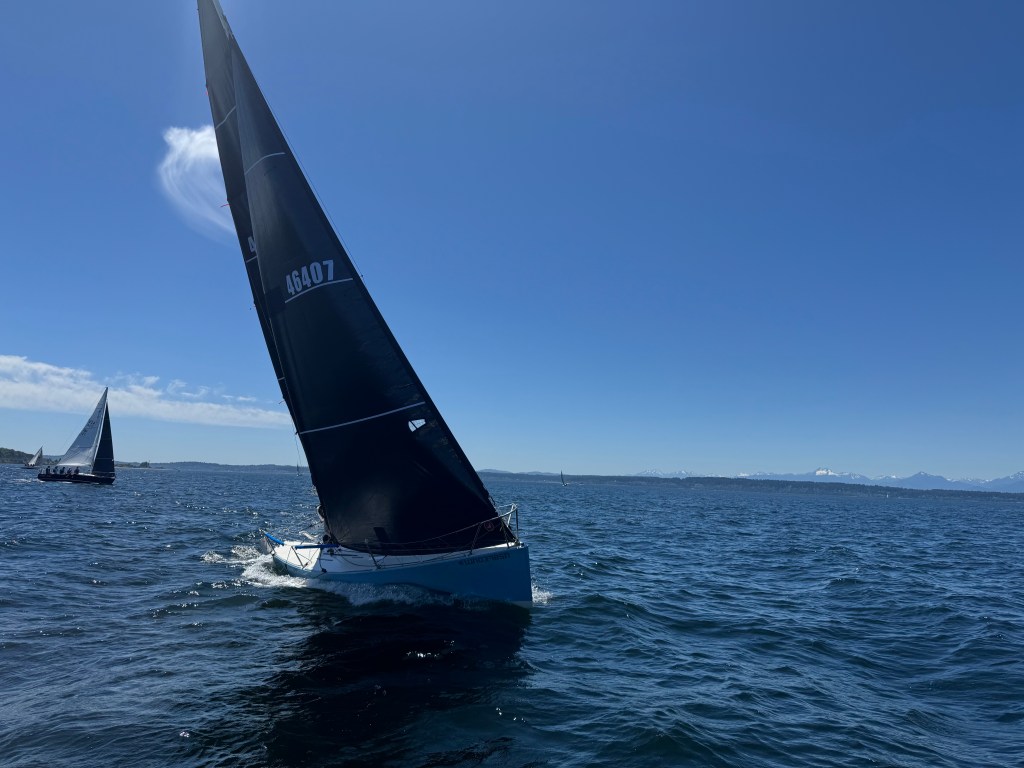
A 20-knot squall rolled in from behind like it had a grudge. Suddenly Blur was on the step, touching 10 knots and rolling past bigger boats like we actually belonged there. It was glorious chaos. We made the leeward mark, executed one classic broach for style points, got the chute down, and powered upwind in 18–20 knots to the finish.
Sixth place. Our best finish of the regatta. Spirits went from soggy to soaring in about three boat lengths.
A Crew to Brag About
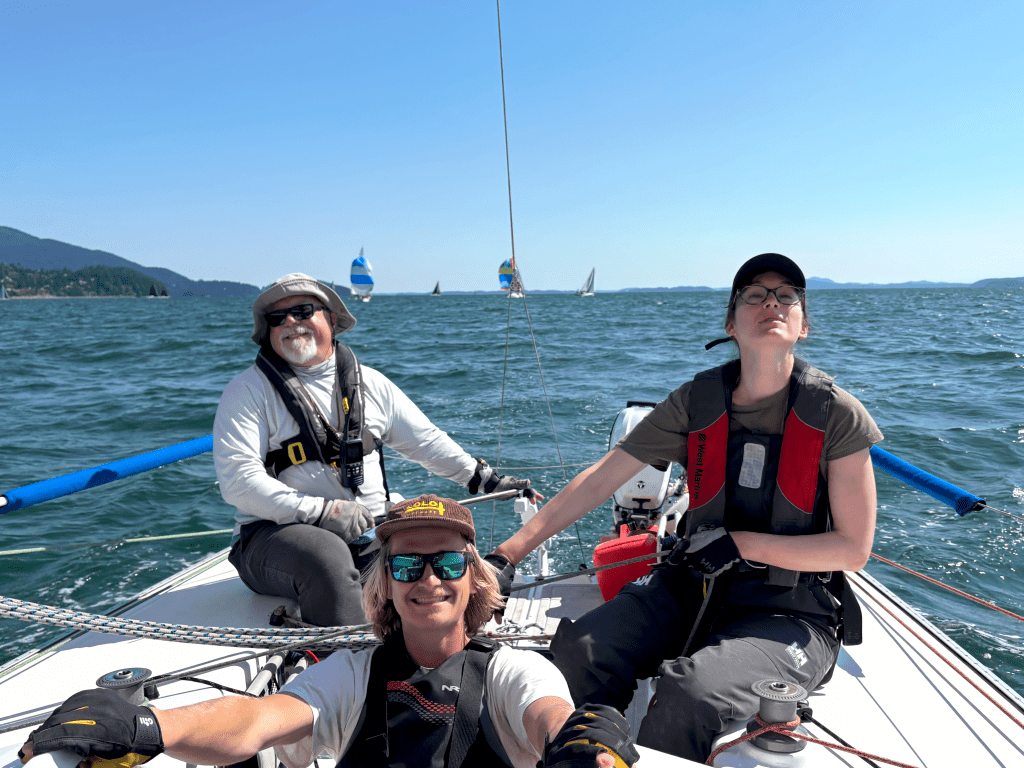
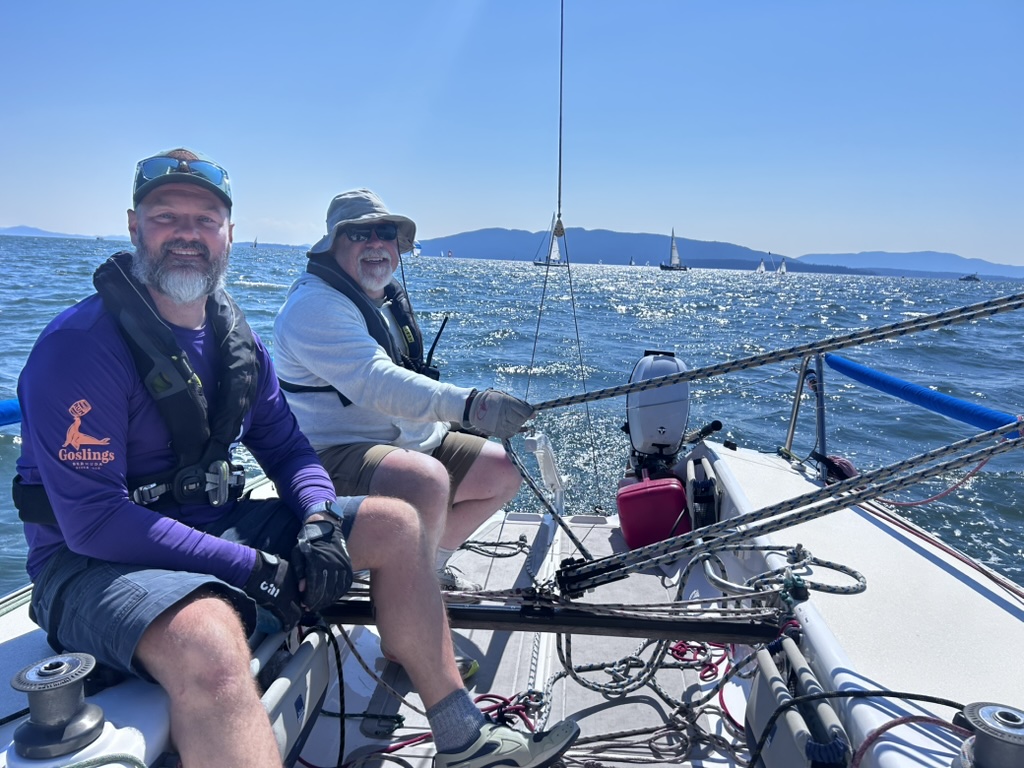
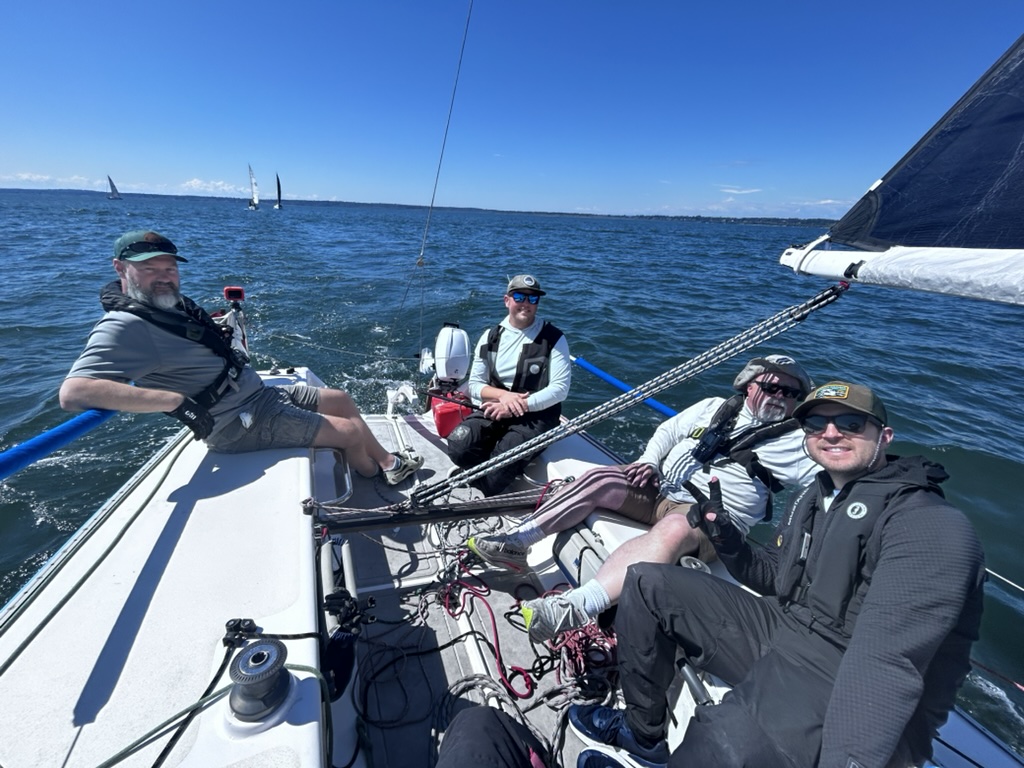
Same crew as Day Two. Same zero experience with Blur. Same unfamiliarity with each other. Yet this wild, last-minute collection of sailors absolutely gelled. Nobody panicked, everyone pulled their weight, and it just worked. I could not have asked for a better group.
The Grand Finale
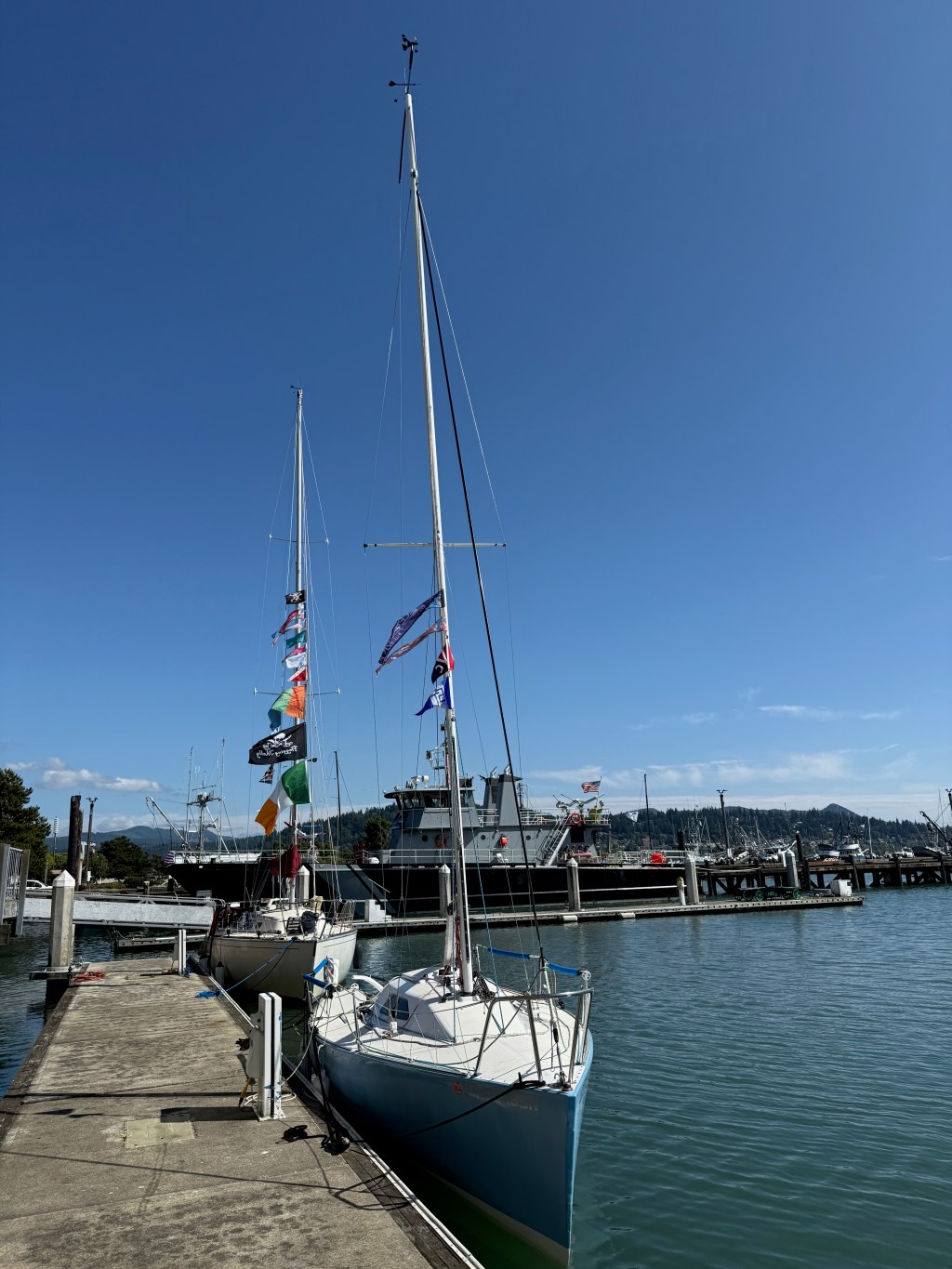
By the time we got back to the dock, everyone was soaked, freezing, and thrilled. Blur got tucked into bed, we got cold beers into hands, and then it was off to the Seattle Yacht Club for the traditional Grand Prix bash. The party alone is worth entering this regatta. Great food, great people. Exactly why this event is such a highlight.
The Results
Our class was stacked with talent. TC took first, Sabotage claimed second, and Madame Pele rounded out the podium. Nine boats total, all tough competitors. More than one person mentioned how cool it was to see a small boat like Blur out there fighting for it. I’ll happily take that compliment.
End of Season
Grand Prix is the finale for us. Blur will dry out for a while, and I’ll spend the winter hitchhiking rides on other people’s boats. Come spring, we’ll wake her up, shake her out, and get ready to rumble again.
Day two of Grand Prix arrived with a forecast that could best be described as “are you sure you want to race a 25-foot boat today?” Twenty to twenty-five knots with gusts maybe into the 30s. I value my paycheck, so I skipped the Friday opener and showed up Saturday ready for chaos.
Instead, I was greeted by exactly zero knots of wind. Not light air. Not patchy air. Zero. So much for forecasting.
I splashed Blur, rigged up, and the crew arrived. Five sailors, all new to the boat. Quick orientation (“There’s the bucket”). Let’s go racing!
A Parade in the Wrong Direction
Once out on the course, the breeze finally decided to make an appearance: a modest 8 to 12 knots from the east. Nothing about that said doom or chaos. So we found ourselves in a classic situation. Forecasts wrong (or at least delayed). Just another day of Puget Sound micro climates in action.
I gave the big boats way too much space at the start and paid for it. We crossed the line 30 to 60 seconds late. My bad. Then off we went on an all-day scenic tour: windward, leeward, West Point, Spring Beach, rinse and repeat. For those not local, that is basically racing from Seattle to Edmonds and back. Multiple times. In a 25-foot boat.
I proceeded to locate every hole on the course. I’d sail right into the middle of the windless hole, have a Goldilocks moment (“Does this feel too slow?”) and then sail off to find yet another hole. We dropped anchor emotionally. The fleet sailed away. We were truly crushing last place.
At Least We Looked Fantastic
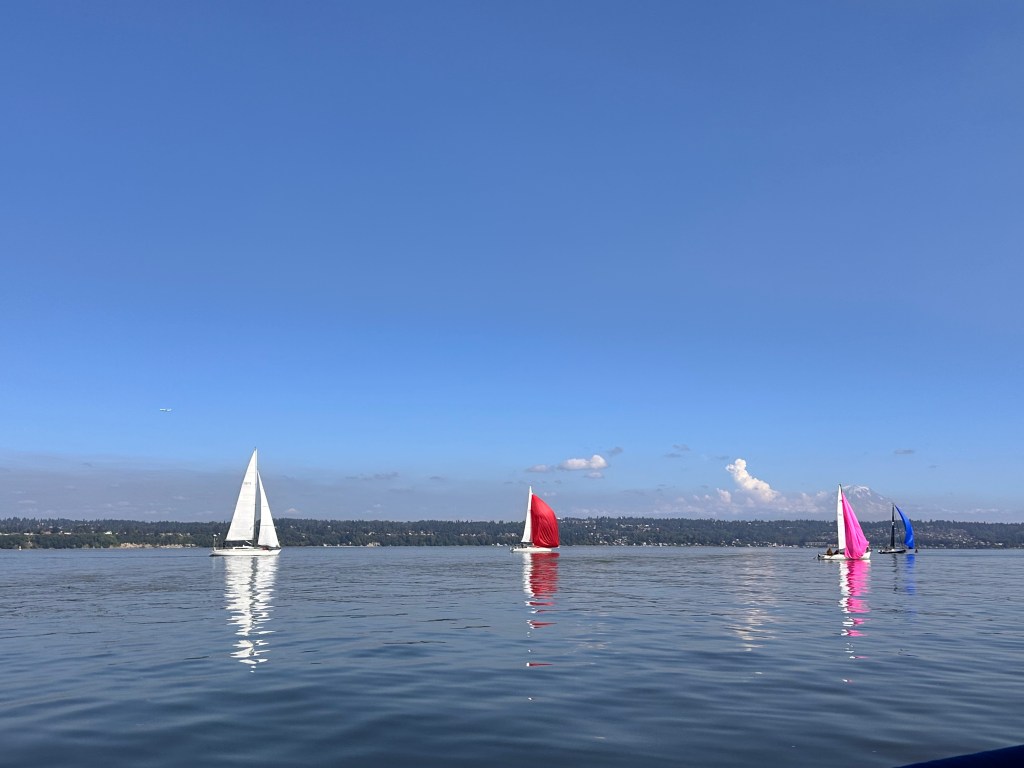
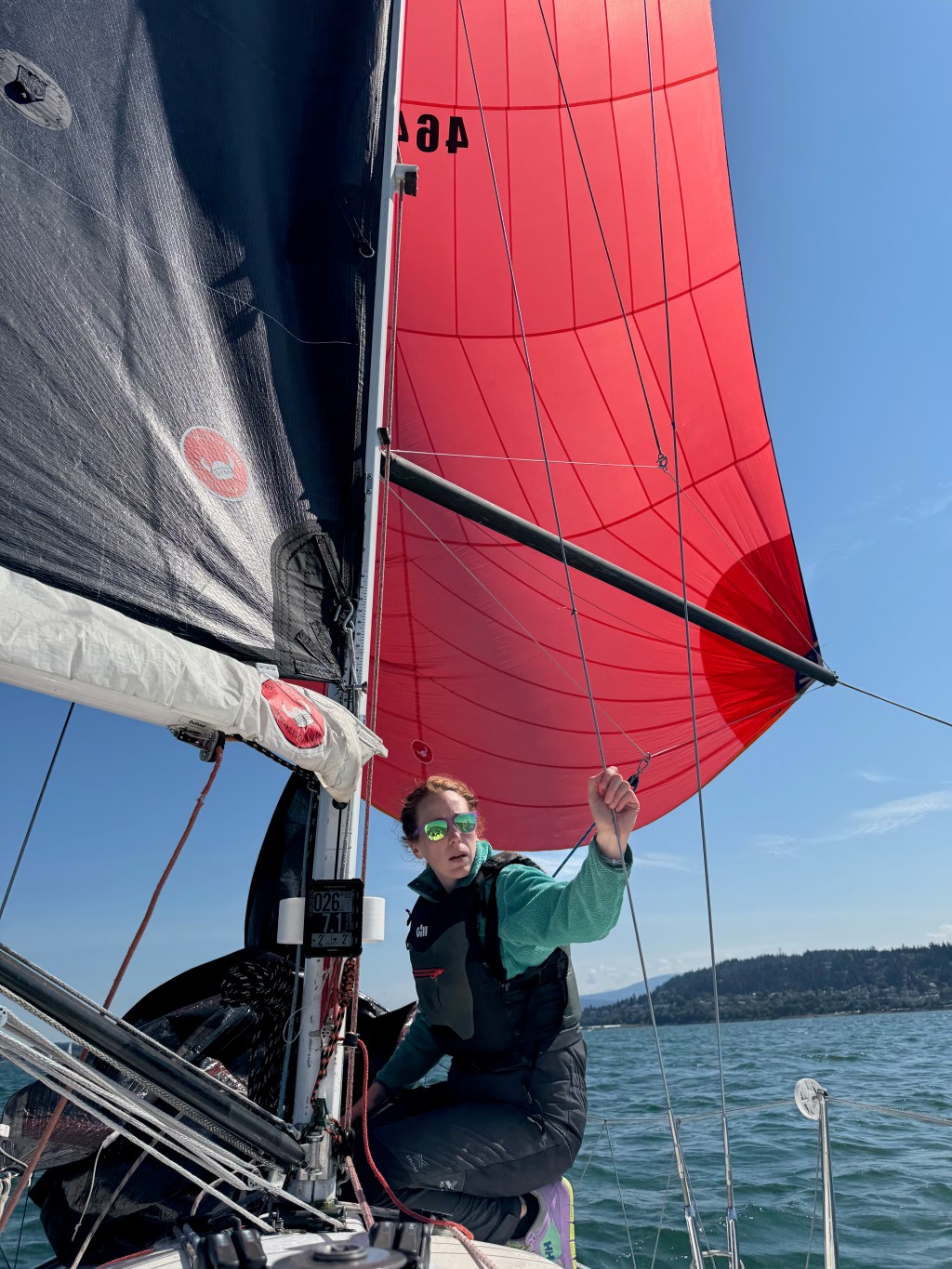
New kite out. All shiny and bright. If there had been a beauty contest, we would have won by a mile. We were slow, but we were pretty. On a day like this, you take wins where you can get them.
The east breeze turned the big legs into a reachy parade. Little chance of catching anyone. Just hang out, enjoy the ride, stay caffeinated.
The Breeze Finds Us
On the second run back toward Spring Beach, the real wind finally decided to show up… from the west. Classic Puget Sound plot twist.
We set the chute. A squall filled in behind us. Suddenly Blur woke up. Twenty knots. Then above twenty. Charging like a proper ultralight. Everyone grinning, knuckles turning a tasteful shade of white.
We set up for our final jibe to round the leeward mark and boom. Big wipeout. Broach city. We dropped the kite, gathered ourselves, and rounded the mark directly into about 25 knots on the nose. Game on.
A Valuable Discovery
Upwind in that stuff requires attention. I muscled the helm, trying to keep Blur from rounding up every other wave. Then Aiden, new-to-the-boat hero that he is, spotted the real problem: our jib cars were too far forward for the No. 3.
Move the cars back. Sheet in. Suddenly Blur settled into the groove like she meant it. Stable. Powerful. Manageable. It felt like unlocking a secret level. That discovery alone made the day worth the bruises.
Last Boat, First Mindset
We slogged all the way back up the course. Spray everywhere. Adrenaline up. Smiles on deck. Yes, we were the very last boat to finish. Entire fleet done ahead of us.
Still, I loved it.
The crew handled a weird, long, unpredictable day like champs. I learned how to race Blur in heavy wind with confidence. That goes in the win column.
We packed up, put Blur to bed, and called it good.
Tomorrow is another day of Grand Prix. The forecast? Probably wrong again.
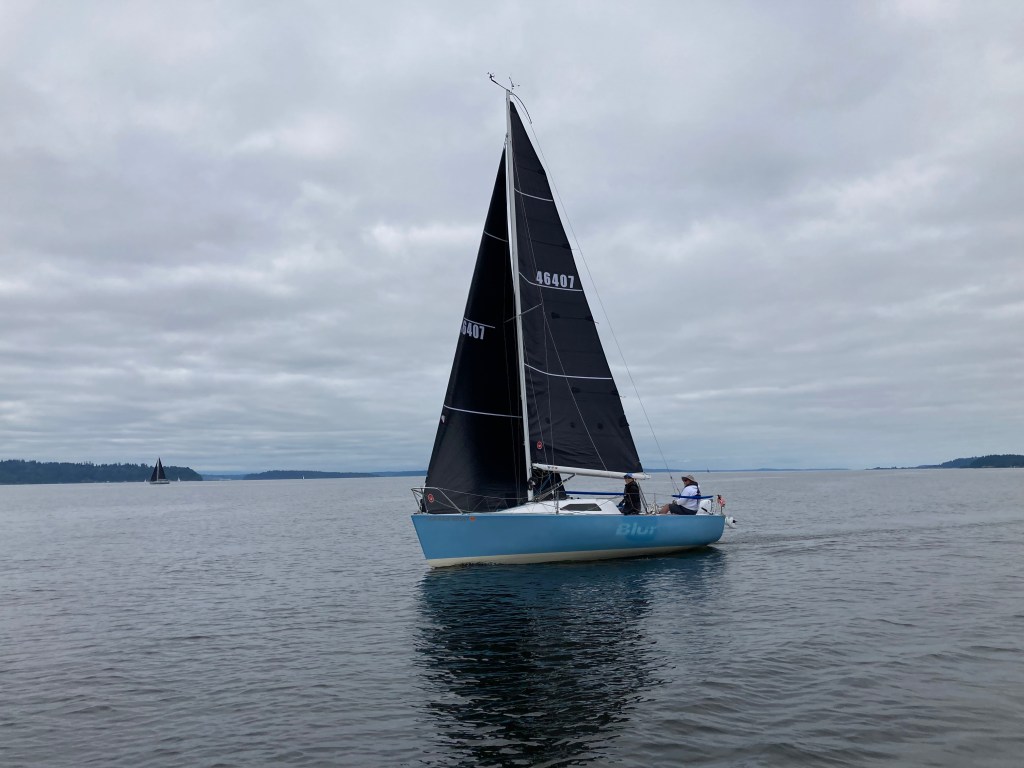
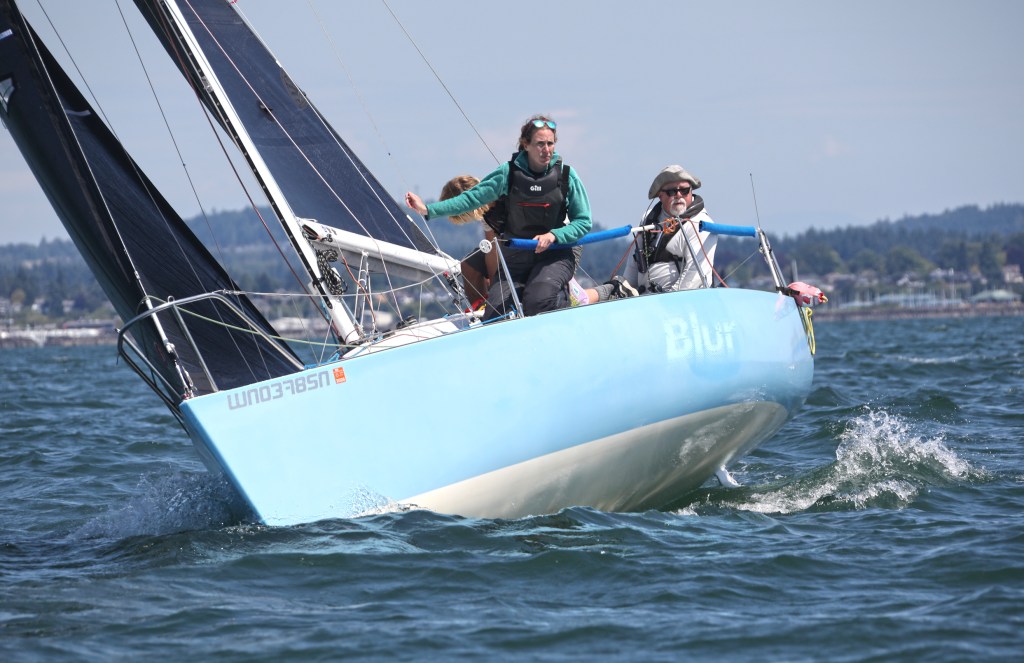
If there’s one thing the Puget Sound Sailing Championship (PSSC) reliably delivers, it’s uncertainty. The forecast for this year’s event was looking… let’s say dubious. It wasn’t clear whether we’d get a gentle day or a full-on ball-buster. With that in mind, I made sure Blur—a B-25 ultralight racer that loves light stuff but needs human ballast to stay upright—was fully loaded with crew. Seven of us on Day 1. Five on Day 2. And a prayer for balance somewhere in between.
The Forecast Fails to Intimidate
When we rolled into Shilshole on Saturday morning, the breeze was blowing a civilized 10–12 knots. Flat water. No whitecaps. Dry skies. It felt suspiciously like a setup, but we weren’t going to complain. We rigged up, got Blur in the water, and were out by 11:00 for the first start.
Originally, we’d registered for the doublehanded class, but one of the boats suffered season-ending damage, and the fleet collapsed. So, with a last-minute switch to fully crewed racing, I scrambled to assemble a new team. Half the folks had never sailed together before, but everyone showed up ready to make it work. My main goal for the day: finish all the races and keep the learning curve pointed roughly upwind.
Race One: The Gooseneck Incident
We were slotted into Class 3, up against two J/109s and a Beneteau 36—boats that make Blur look like a toy dinghy. The starting line, thankfully, was enormous—so big that I could own one end without getting buried under the big boats’ sails. A gift from J/105 class of 17 boats.
Just before the first start, as we were tightening halyard tension, the boom popped clean off the gooseneck. Turns out we’d lost a nut somewhere. Nothing says “good morning” like your boom suddenly deciding it’s had enough of racing. We lashed it back together with Dyneema—ugly but functional—and got back on the line. (Pro tip: Dyneema fixes almost everything except bad starts)
Only three boats made it off the line—another had gear failure—so we took third. Respectable, considering Blur was the smallest hull out there by a good 10 to 12 feet. Twice around the course, and we came back grinning. The boat was solid. The crew was finding rhythm. Not bad for a first round.
Race Three: The Great Kelp Catastrophe
By the time the third race started, the fleet was back to four boats, and things looked promising. That lasted all of thirty seconds. The moment our prep signal sounded, we plowed straight into a massive patch of kelp—so thick it wrapped around the rudder and stopped us dead. Full stop. Like hitting an invisible net.
Cue five minutes of controlled chaos as we backed the boat down, freed the rudder, and tried not to swear too loudly. We made the start with about thirty seconds to spare – definitely not ideal – but got across cleanly and settled into a good groove. The breeze stayed steady at 12–14 knots, the teamwork clicked, and we sailed a clean race. Another fourth-place finish, but the crew was gelling, and the boat felt fast.
Race Four: Smooth Sailing (Sort Of)
The Forth race was a quick one—just once around. I took the helm again, and we sailed it beautifully. Clean tacks, fast downwind legs, and a rhythm that finally felt natural. Of course, we still finished fourth, because physics is cruel and the other boats were, well, bigger. But there’s a certain satisfaction in sailing a small boat well against giants. We didn’t win the race, but we didn’t embarrass ourselves either, which is a win in my book.
Back at the Yacht Club, there was clam chowder and tall tales. Spirits were high. No one had gone overboard. Nothing was on fire. A good day by any metric.
Day Two: From Gusts to Glass
Sunday morning looked intimidating. Reports were coming in of 26-knot gusts off West Point, and Blur doesn’t exactly thrive in that kind of breeze without extra ballast. But by the time we got to the start line, it was only puffing 7–8 knots. Then 6. Then… nothing.
We started a race in dying wind, wandered into a few holes, and generally looked lost—along with everyone else. The Race Committee eventually called it off (thank you, Charlie), which was absolutely the right move. The convergence zone rolled through, and for two long hours, we drifted around like colorful corks.
Then, mercifully, the northerly filled in. Charlie reset the course near the marina breakwater, and we got one last, lovely race. 12–13 knots, sunshine, and a short course that Blur could really stretch out on. We sailed hard and came in third—our best finish of the weekend.
The Wrap-Up: A Small Boat with a Big Heart
Two thirds and three fourths put us solidly in fourth overall for the regatta, which—considering the size difference in the fleet—felt like a win. The weather, which had been forecast to be miserable, turned out gorgeous. Cool, sunny, and full of surprises. We learned a ton, and fixed some weird problems.
All told, PSSC 2025 was a success. The crew was game, Blur was fast, and the sailing was dry. For a boat that thrives on chaos and caffeine, that’s a perfect weekend.
Where Did Everyone Go?
I’ve noticed something odd in recent years: the big end-of-season races like PSSC and Grand Prix seem to be turning into exclusive gatherings of J/Boats and big yachts. The ragtag fleet of small boats that used to bring chaos and color to the starting line? Vanished. Gone.
By “small boats,” I mean those sweet 20- to 30-foot pocket rockets that used to pack the line — the Moores, Melges, Olsons, Santa Cruz 27s, Thunderbirds, and every other slightly-leaky, occasionally-overpowered local legend. They’re still around — you see them at Monday night Sloop Tavern races, tearing up the course and talking smack at the bar. But when it comes to the big regattas? Poof! Gone.
The Case of the Missing Small Boats
What happened? Were they abducted by aliens? Kidnapped by TP52 owners for ballast duty? Or perhaps they’ve gone to that great boatyard in the sky, where every halyard runs freely and no one ever forgets to close a seacock.
I can only speculate. Maybe it’s the cost — two or three days of racing can easily run you a couple hundred bucks (which, these days, is approximately the price of a Seattle latte). Or maybe it’s the new rating systems — PHRF giving way to ORC, complete with fresh paperwork, fresh fees, and fresh headaches.
And then there’s the weather. Let’s be honest: by late October, the “refreshing breeze” has turned into “horizontal rain,” and enthusiasm can freeze right along with your fingers. You’ve got to be a die-hard to leap out of bed for buoy racing when the sun rises at 8:00 and sets at 4:30.
The Sound of Silence
Back in the 90s, the small boat fleets at PSSC were rowdy. It was tight, intense racing — one-design in spirit if not in class. The docks were loud, the beers were cheap, and the trash talk was world-class.
Now? The scene feels like the morning after a great party that everyone forgot to invite you to. The competition is thin, the docks are quiet, and finding crew feels like recruiting for a polar expedition — all the good pirates are already spoken for.
Giant Killer Mode: Activated
But you know what? I’m not crying into my IPA. If it means my little boat lines up against a fleet of giants, so be it. Every David needs a Goliath or two. I’ll happily take my role as the underdog — the scrappy little boat punching above its weight.
So here’s my mission: I want to see more small boats on the line. I want to see those Moore 24s, Olsons, and T-birds back in the mix at PSSR, PSSC, and Grand Prix. Let’s bring back the chaos, the competition that makes this sport what it is.
See you on the line — and one of these days, I swear, I’m going to correct out over a TP52.
Saturday morning started off cool and cloudy, with a layer of fog out on the sound at Shilshole. The wind was light, drifting between 3 and 5 knots from the south. After our recent trend of warm weather, this change caught a lot of folks off guard. Down the Sound is held during the slow, balmy late summer. Typically, you can expect to bob around in little to no wind and bake under blazing sunshine. Not this time. As my crew, Laura Lewis, and I prepped Blur for the race, we found ourselves pulling on extra layers and telling each other, “It’ll all burn off by lunchtime.”
Down the Sound is a double- or single-handed pursuit-style race, so the starts are staggered according to the handicap of each individual boat. We got out to the starting line early and were pleased to discover a very reasonable 5–8 knots of wind waiting for us there. We watched as Blue Jeans, a C&C 27, was first off the line, making good time toward West Point. Soon after, Perfectly Strange (Pocket Rocket 22), Yeah Dogg (Olson 25), Moore Pun (Moore 24), and Impulsive(J/30) swiftly followed suit. This was our class for the race. I’ve raced against all of these boats before and knew they were not to be taken lightly. There were no mistakes—everyone was on the line right on time, and swiftly dwindling in the distance to windward when it came time for Blur to start.
We hit our start time perfectly and gave chase to our competition. The wind stayed around 5–8 knots, so we had the big jib up. After a couple of tacks, we were up to Magnolia Bluff and trading places with our first competitor, Impulsive. As we came around West Point, we were on port tack and got an amazing lift that had us basically pointed 180 degrees straight down the sound toward our destination. We passed Impulsive and had the remainder of our class in our sights as we proceeded to work our way south. They all still seemed impossibly far off.
The good news—unexpected really, given the gloomy forecast—was there was a decent carpet of wind as far as the eye could see. The breeze fluctuated, and there were occasional holes here and there, but on average it was better than previous years. Blue Jeans was doing an extraordinary job and used their first start to their best advantage. They were just a dot on the horizon. We had Yeah Dogg, Moore Pun, and Perfectly Strange in a group about a quarter mile ahead of us. It seemed like a lot of ground to make up against some very good sailors. As we sailed south across Elliott Bay toward Blake Island, we took a conservative approach in the relatively light breeze. No tacking or maneuvering unless there was a compelling reason—just keep moving.
That turned out to be a good strategy. By the time we reached Blake Island, we had caught up to the group. Behind us, you could see the J/105s (Moose Unknown, Panic, Puff, Peer Gynt, and Jaded) and the Evelyn 32, Ratfish, making tracks to overtake us—but still a little ways off. They were not a factor yet. We started trading tacks with Yeah Dogg, and by the time we reached the northern tip of Vashon, we had overtaken them. Moore Pun and Perfectly Strange were right in front of us. However, this is where the wind started to falter and got really light. We were near Dolphin Point and all we could see was dead calm between us and Three Tree Point (the official halfway point of the race). Everyone was coming to a stop. It was a parking lot.
The entire fleet piled up at this point. We moved in closer to shore and followed Perfectly Strange to the right along Vashon for a bit. Then we saw Moore Pun getting into some breeze out in the middle of the sound off to the left, so we tacked back and tried to cover them. Right or left—which way to go? I looked back over my shoulder, and the guys on Perfectly Strange were gliding gracefully along the shore like they were on ice, barely even touching the water. It was a little freaky how well they were sailing that boat. As it turns out, indecision in the middle is exactly the wrong choice. We lost our momentum and parked ourselves dead center in a hole. As we were contemplating our poor choice, the rest of the fleet said, “Bye-bye,” and proceeded to sail around us. By the time we managed to latch on to a passing zephyr, the entire fleet was a good half mile or more in front of us. I mean everybody. We had gone from leading the fleet to dead last. Ah, the joys of light air sailing: transformed from wily super-genius to idiot in just a few short minutes. I guess that’s how it is—the coyote never sees the rock coming.
Once we were moving again, we just put our heads down and started working our way toward Three Tree Point. Along the way, we started picking off boats at the back of the fleet, one at a time. We passed Bella, a big, beautiful Hanse 455. Then we finally managed to overtake the boat that started first in our class, Blue Jeans. As we closed in on the point, we overtook Impulsive. At this point, we had moved up from dead last to fourth in our class. We had successfully made it to the halfway point before the cutoff time (not always a given in this race), and we only had three boats between us and first place. We set our sights on our next landmark, Point Robinson. Our remaining competition still seemed impossibly far away.
I think it was around 3:00 in the afternoon at this point. The wind got lighter the closer we got to Point Robinson. The good news is that the sun finally graced us with its presence. As we neared the point, we managed to overtake Yeah Doggand claw our way back into third place. However, just on the other side of Point Robinson you could see that the water was dead calm. This area of the south sound, Poverty Bay, always seems to have light air, and it looked like we were headed for yet another parking lot. We decided to follow Perfectly Strange and cut the corner at the lighthouse as close to the shore as possible. We were so close to shore I think I could have handed the kids playing on the beach a sandwich as we drifted by. The water was flat, but the current pushed us out into the bay. There was the barest hint of a wind line forming toward the middle. As we rounded the corner, I just pointed the boat directly at Brown’s Point—roughly five miles in the distance. We trimmed our sails for that direct route and had just enough breeze to start Blur moving in that direction. Perfectly Strange followed some of the J/105s who were seeking more wind across the bay. Moore Pun took the middle road and sailed down the bay parallel to us.
The way I saw it, Perfectly Strange was in the lead and sailing spectacularly well. They were sailing a longer route, but if they found more wind, they would easily crush it and win. On the other hand, Moore Pun is a Moore 24, and I have never managed to beat a Moore in a downwind race. They are obscenely fast little boats with a spinnaker up, and I had every reason to worry about beating them in a straight-up spinnaker drag race to the finish. We were behind both of them, but we had a small chance—if things played out right.
The wind obliged by filling in from the east. We had a solid 8–9 knots of breeze pushing us toward Brown’s Point. I don’t know if it was Laura’s trimming (probably), the current (possibly), or the favor of the gods (not likely), but we started to overtake Moore Pun. I held my breath for what seemed like a mile as we sailed past them to windward. Meanwhile, Perfectly Strange, in their quest to find wind across the bay, came up short. They were moving well and had good breeze, but going that extra distance had cost them valuable time, and it soon became apparent that we had also overtaken them by going straight for the finish. As we closed in on the lighthouse at Brown’s Point, we had put both our competitors firmly behind us. Both Laura and I were in is-this-really-happening shock. We didn’t want to say anything and jinx a possible first-place finish. But the question was definitely on our minds… did we just come back from dead last and take first place?
Yes, we did. We crossed the finish line (looking very stylish, I might add), high-fived, and then headed for the dock. The party at Rock the Dock was awesome. There was free food and beer, so a good time was guaranteed. Awards were given, there were a couple of birthdays to celebrate (Duncan and Lisa), and perhaps a few stories told. I bailed out around 10, but the party ended up going up the hill to McMenamins Elks Lodge and continued well into the early hours.
When I stumbled back down to the boat early Sunday morning, it looked a lot like the Saturday start—gray and chilly with a 5–8 knot breeze blowing. The guys on Perfectly Strange were cooking breakfast right on the dock and were kind enough to share a little with me (thanks). Boats gradually started leaving the dock as we all had to make the one-hour trek over to Spring Beach for the Day 2 start line. It was a quiet ride over under power as we nursed our coffee and maybe a little hangover. My biggest concern was the start. My experience has been that the currents around Spring Beach can be surprisingly strong, and the wind fickle. It’s deceptively easy to get swept over the start line prematurely. Getting caught like that can ruin the start of an otherwise great race.
We watched closely as our class all started before us. The wind was coming from the south, so it looked like a spinnaker run down Colvos Passage. Our turn came and we timed it almost perfectly, with our chute up and headed down the passage in a very modest 3–5 knot breeze. Early on, we managed to slowly advance past Impulsive, but the other boats all seemed to hold a constant and very substantial lead. Blue Jeans raced like they were being chased by the IRS. They were way out in front and giving up no distance. On Blur, we settled in and worked our way down the passage. There were very few passing lanes. Everyone had their spinnakers up, and the narrow passage didn’t leave a lot of options for taking big risks or finding passing lanes. As we approached the northern end of Vashon Island, we finally managed to overtake Yeah Dogg. We were now in fourth place, with Blue Jeans, Perfectly Strange, and Moore Pun solidly out in front of us. Around this time, Ratfish and the J/105s caught up to us. Ratfish, like the previous day, screamed along. They looked like they were going to take line honors for a second day straight.
When you get to the northern end of Colvos Passage, there is a tough tactical decision to make. Blake Island sits almost directly in the mouth of the passage, and you have to go either left (to the west of Blake) or right (out into Puget Sound and Elliott Bay). As we approached Blake, a couple of things were clear. We could see wind on the left side of Blake, and out on the sound it looked dead flat. I’ve faced this challenge before. Going out on the sound is the more direct route, but often there are tough currents and the wind can be fickle. Trying to sneak west behind Blake Island can keep you in the wind longer and offers the tempting possibility of sneaking ahead of folks who go the other way. Based on experience, I can tell you that it’s a real roll of the dice. Sometimes you win, sometimes you lose.
The majority of the fleet, including Blue Jeans (leading our class), elected to go out into the sound. However, Perfectly Strange, Moore Pun, Blur, and Panic (J/105) opted to go west behind the island where there appeared to be more breeze. Honestly, I could have gone the other way, but I wanted to stay in touch with the faster boats in the class, Perfectly Strange and Moore Pun. So I followed them. This turned out to be the right call. The wind on the west side of Blake Island was steady and strong. We cut behind the island and then popped back out into the sound to find that the rest of the fleet had been sailing very slowly in light breeze. By sailing a little more distance in stronger breeze, we had cut to the head of the line. Blue Jeans was now behind us, and we were the top three boats in our little group.
We rounded the shoal just south of Blakely Rock and pointed the bow directly at West Point, our next destination en route to the finish line. This was turning into a 20-mile-long spinnaker run. It was apparent by now that overtaking people today was a lot harder than the previous day. We were slowly making up ground, but catching folks flying under spinnakers is more challenging. By the time we were halfway to West Point, I was absolutely convinced there was no way we could catch up to Perfectly Strange and Moore Pun. They were sailing really well and not making any mistakes. Then the great randomizer hit: cruise ships leaving Elliott Bay. Those giants—one of them moaning the theme song from The Love Boat like a love-sick whale—came barreling out of Elliott Bay at full-freaking tilt. They were aimed right at the middle of the fleet. It was chaos. Big, fat, beautiful chaos.
When the dust cleared and the cruise ships were past, we found ourselves in first place, leading the fleet! Moore Pun and Perfectly Strange had to dodge the cruise ships, and we managed to slip by them. As we rounded West Point, we had Moore Pun right on our tail and Perfectly Strange coming in behind them. At this point, for one brief moment, I felt like one of the luckiest sailors around. We had worked our way up through the entire fleet to first place for a second day in a row! However, remember what I said about Moore 24s being wicked fast downwind? Yeah, they were right on top of us. We sailed into a soft spot, and they got the advantage and managed to sail past us to retake the lead. We crossed the finish line just a few seconds behind them.
It was an exhilarating way to end the day, and I want to give a shout-out to the Moore Pun team for their amazing recovery after the cruise ship chaos. They fought hard for that win. However, it was a win for us too, for a couple of reasons: we won first overall in our class based on elapsed time for both days, and… we’ve never managed to actually finish that race before. Down the Sound is often a tough race to finish. The wind has been known to completely shut down and leave you stranded. One false move and your day is over.
We got lucky this time. The wind was better than forecast, and better than usual. I’ll also take a little credit. Laura and I did a great job of sailing the boat. There is a lot of difficult decision-making and execution that has to take place in a light air race. We were patient, we executed well, stayed focused, and we didn’t take any unnecessary risks.
If you’re looking for a light air challenge, tough competition, and a great party, you should give Down the Sound a try.
Day five in Bellingham didn’t disappoint—unless you were short-handed, like us. The breeze was up early, a solid 18 to 20 knots right out of the gate, and the sea state matched: steep chop, big gusts, and serious pressure.
We had three races lined up, but we were down a crew member and it showed. With only four people aboard, we were fighting to keep the boat under control. The boat was fast and pointing well enough, but in those conditions, we were desperate for extra weight on the rail to steady things out. Without it, we got tossed around like a toy boat in a washing machine.
Complex maneuvers? Forget it. We were overwhelmed—physically and tactically—and it showed in the results. We got hammered in all three races, finishing somewhere around fifth or sixth each time. The details are a bit fuzzy; I think I’ve blocked it out.
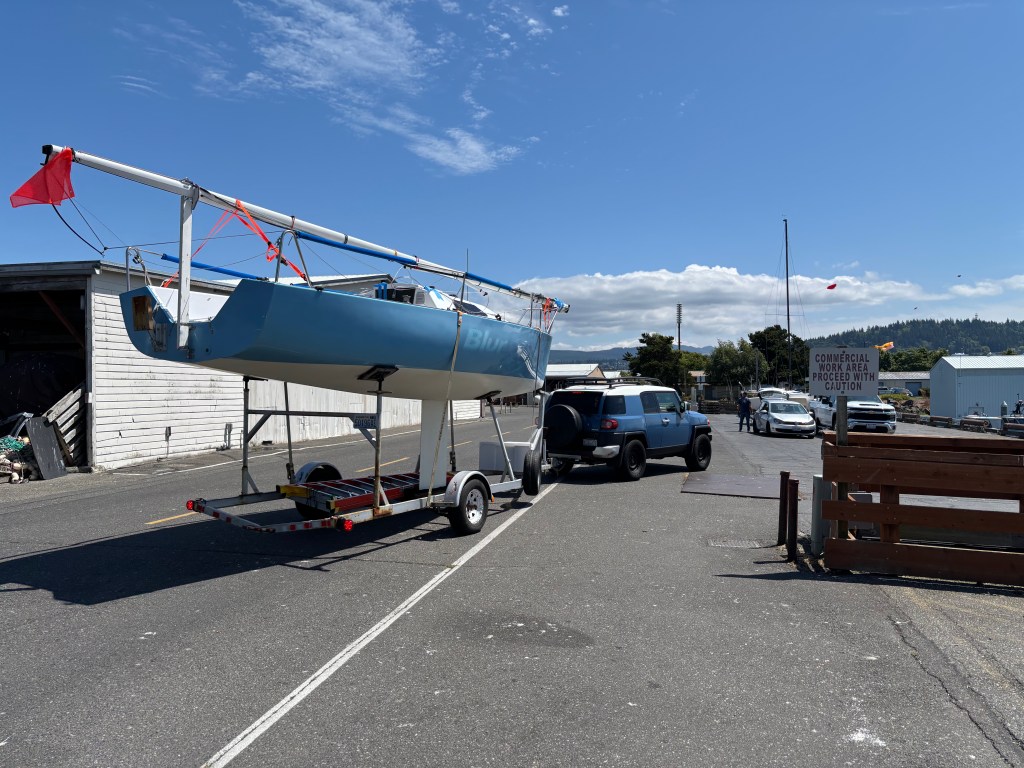
It was the kind of day that rewards a fully crewed, dialed-in team—and punishes anyone shorthanded. By the time we got the boat back on the trailer and packed up, I was wiped out. Utterly drained. We wrapped up the regatta sitting in fourth overall, just missing the podium. Not the ending we hoped for, but still our best performance at Race Week to date.
We held third place three out of five days, and had some of our cleanest, fastest sailing ever. The competition was fierce but fun—especially Zephyr and her crew, who ultimately edged us out for third. Racing them was an absolute blast. The kind of rivalry where you’re trading barbs, cheering each other on, and cracking jokes every time your boats cross paths. That’s what good racing is all about.
So yeah, I’m disappointed we didn’t hang onto a podium finish. But honestly? This week was a gift. Five straight days of champagne sailing, steady breeze, and great people. I’ve never seen a race week deliver so consistently on conditions. I’m running on adrenaline and ibuprofen, totally rung out, and I wouldn’t have it any other way.
We left it all on the water. And that, my friends, is how you finish a regatta.
Thursday’s race was a pursuit format—a fun twist where each boat gets its own start time based on handicap ratings, so in theory, everyone finishes at the same time. It’s a great way to mix boats of all shapes and speeds into a single race. The course? A 20-nautical-mile tour starting in the harbor, heading south to Eliza Island, then a loop around Vendovi Island and Viti Rocks—clockwise or counterclockwise—before racing back to the harbor.
The twist? You choose your direction around the islands. And we had no idea which was better.
With zero local knowledge and no secrets whispered by old salts, we were left to squint at current charts, poke at weather apps, and make our best guess. We settled on counter-clockwise.
Cue the flashback to Indiana Jones and the Last Crusade. You remember the scene: the villain picks the wrong grail and turns to dust, and the knight solemnly declares, “He chose… poorly.”
Well, my friends, so did we.
The day started off beautifully. Wind in the 16–20 knot range, reefed main, number two headsail, and we were absolutely flying upwind toward the islands. It was glorious. And then… it wasn’t.
We picked the wrong direction. The current slapped us in the face. We tacked and fought and drifted and cursed our way around the rocks. A slow-motion cascade of small, compounding errors—nothing dramatic, just death by a thousand tactical paper cuts. By the time we emerged from our navigational misadventure, we had managed to drop to last place.
The ride home was long, quiet, and humbling. We hoisted the chute and flew downwind toward the finish with a mix of resignation and reflection. Somehow, we clung to third place overall in our class—but just barely.
Every sailor knows this truth: some days, you just get humbled. Thursday was our turn. But despite the tactical trainwreck, the conditions were stunning, the wind was exhilarating, and Bellingham once again served up a spectacular day on the water.
By day three of Bellingham Race Week, the romance of sailboat racing starts to feel a little… well, sore. Every muscle is complaining, my knees sound like a bowl of Rice Krispies every time I climb on or off the boat, and even my fingertips are tender. But here’s the kicker: our sailing today? Absolutely dialed in.
We raced four times, and in every race we finished third or better. OK fine, we mostly finished third. But it felt fantastic. Our boat handling was clean, our communication was sharp, and our results were consistent. The weather couldn’t have been better either—10 to 15 knots of steady breeze all day long, with just enough shifts to keep it interesting.
Best of all? My starts were chef’s kiss. After a rough day yesterday, I finally got my timing and positioning right. We hit the line powered up, in phase, and ahead of the fleet in almost every race. Not to brag (okay, maybe just a little), but it felt amazing. Maybe all that flailing yesterday was just practice for the magic today.
The crew really stepped it up too. We found a new maneuver at the leeward mark that tightened up our rounding and shaved precious seconds off each leg. That kind of on-the-fly improvement is one of the things I love most about a week like this. After five days of intense sailing, everything sharpens. By the time I’m back at Shilshole, I feel like a monster—confident, tuned in, and doing things that felt tricky just a week ago.
Sure, this week hasn’t been without its challenges. Getting our cars towed and dealing with mounting physical exhaustion wasn’t exactly in the game plan. But we’re rolling with it. The vibe on the boat is good, the learning is real, and our performance is trending up.
So, this is the inaugural year for Race Week in Bellingham, and let me say—on paper, it has everything going for it. Quaint college town? Check. Great food? Yep. Beautiful scenery? Absolutely—snowcapped peaks, sparkling water, and just enough boutique charm to make you think, Hey, maybe I could live here.
But wait, there’s a “but.”
Turns out Bellingham has a little Tuesday night ritual downtown called street cleaning. Sounds innocent enough, until you learn that it involves tow trucks prowling the streets like apex predators at 2:30 AM, mercilessly dragging away any car foolish enough to be asleep at the curb. That’s right—two of our crew cars, including mine, were spirited off into the night like a bad subplot in a city planning thriller.
By the time we paid the ransom (err, towing fee) and reclaimed our vehicles from the automotive gulag, Tuesday had already earned a special place in my personal hall of infamy. I was tired, grumpy, and under-caffeinated—basically the ideal mindset for high-stakes racing.
Still, we made it to the course on time, and Blur was back on the water. That said, Day Two didn’t live up to the fairy tale that was Monday. Our starts were… let’s say “interpretive.” Either we were late, out of position, or just jumped the gun entirely. Not exactly textbook form. The silver lining? Blur is still faster than regret, so we clawed our way around the course pretty well—just not well enough.
We slid a few places over the course of three races—mostly fourths and fifths—and while the boat was performing, the humans were clearly stuck in second gear. The weather, at least, was playing nice: fog in the morning, followed by sunshine, 8 to 10 knots of breeze, and a start line that looked more like a demolition derby than a sailboat race. If Monday was aggressive, Tuesday was full-contact. The protest room was doing brisk business by the end of the day, which tells you everything you need to know.
On a tactical note, the racecourse started to shift—slightly less of the standard “bang the left corner” strategy. We found a few gains sneaking to the right on the upwind legs, and by mid-afternoon, the fleet was fanning out like someone had kicked over a box of toothpicks. Not chaos—just a little more nuance.
We did manage to squeak out a third in the final race, which felt like a moral victory considering the sleep deficit and mild existential crisis from earlier.
Back at the marina, the post-race theme was Christmas in July—because nothing says “sailing regatta” like fake snow, tacky sweaters, and rum drinks in Santa mugs. Cheers to that.
After the pavilion festivities, we wandered into town and blew off a little steam.
If I ever had to introduce someone to the sport of sailing, Day 1 of Bellingham Race Week would’ve been the perfect way to do it.
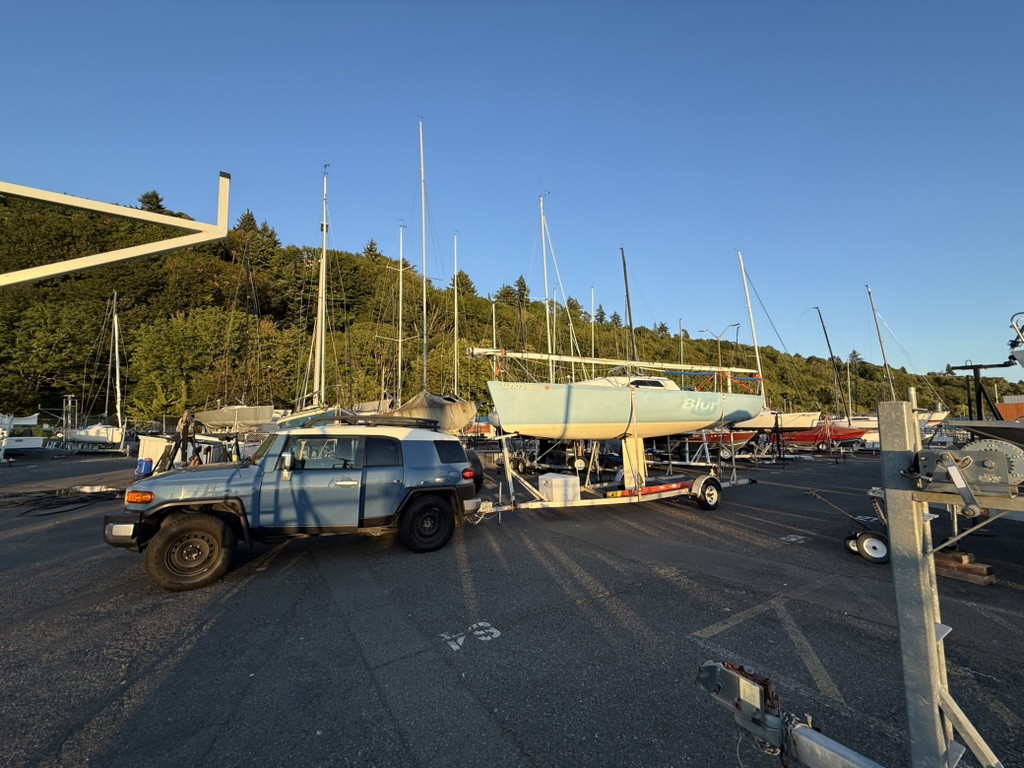
We trailered the boat up from Shilshole on Sunday, got her rigged, splashed, and tucked into the harbor. The weather? Absolutely stunning—70 degrees, sunshine, snow-capped mountains on the horizon, and of course, Bellingham Bay. Couldn’t have asked for a better welcome.
The Racing
We had a guest tactician, Alex Simanis from Ballard Sails, on the boat for the day and it really showed in our performance. He played boat whisperer and helped us up our game across the board. From improving the rig tuning to fine tuning the sail trim, he did an amazing job.
Our first race of the day started after a short delay. We’re sailing in the PHRF B division, so we got to watch all the other classes start before us—so we had front row seats. The big ORC boats, the sleek J/105s and J/80s, the nimble J/70s, and the Melges 15s all made for some exciting starts and tight action.
I’ll admit it: starts are my favorite part of racing. Maybe I’ve got a tiny adrenaline junkie buried in there somewhere, but the chaos, the yelling, the jostling for position—it’s electric. And when you nail it? When you pop out on the line with clean air and good speed? For just a second, you feel like a rockstar.
That first race, we sailed clean and fast and came in third in our class. Not a bad way to start the week.
Wind and Tactics
The breeze in the morning was steady—around 13 to 15 knots—which gradually tapered off as the day went on. The course setup heavily favored the left side of the bay, so most of the fleet bee-lined it toward Fairhaven, hit the weather mark, then gybed their way back down to leeward. Tactically, it was pretty locked in—go left, or get left behind.
Then in race two, we found our groove, hit our shifts, and brought home our first bullet of the week. Race three, we got another third. By the end of the day, we were sitting in second place overall in Class 7—easily one of our best performances to date. I was over the moon.
After the Racing
After a full day on the water, we wrapped things up at the race pavilion with beer, music, and the usual suspects. It was great to reconnect with old friends, swap stories, and soak up the atmosphere. Nothing quite beats tired bodies, sunburned smiles, and a good result on the scoreboard.
The morning of the race was absolutely spectacular—one of those rare, idyllic Seattle days. Clear skies with a few high clouds, temperatures around 80°, and a steady northerly breeze blowing at 10 to 15 knots. It was the kind of day sailors dream of. We got the boat in the water early, with plenty of time before our 11:23 AM start. As the time approached, we realized we were a bit too far from the starting line. Not disastrously so, but enough that we ended up crossing the line about 20–30 seconds late.
Lining Up Our Race Plan
Our race strategy was straightforward and aligned with the rest of the fleet. We planned to head north to Meadow Point, cross over to Jefferson Point, set the chute, and run downwind to West Point. From there, we’d take a short windward hitch back to the finish. Given the flood tide that lasted all day, heading in any other direction would’ve meant fighting the current on the long leg between West Point and Jefferson Point—something nobody seemed willing to do.
Upwind to the First Mark
The quick ride to Meadow Point was smooth and uneventful. We rounded it cleanly and began our upwind leg toward Jefferson Point. The wind held steady around 10 to 12 knots, with occasional gusts up to 13 or 14. By the time we neared Jefferson Point, we were leading our fleet. Of course, in classic fashion, the mark wasn’t quite where it was supposed to be, and we had to do a bit of searching before we found it. But we rounded cleanly and moved into the next leg.
Spinnaker Set and Speed Run
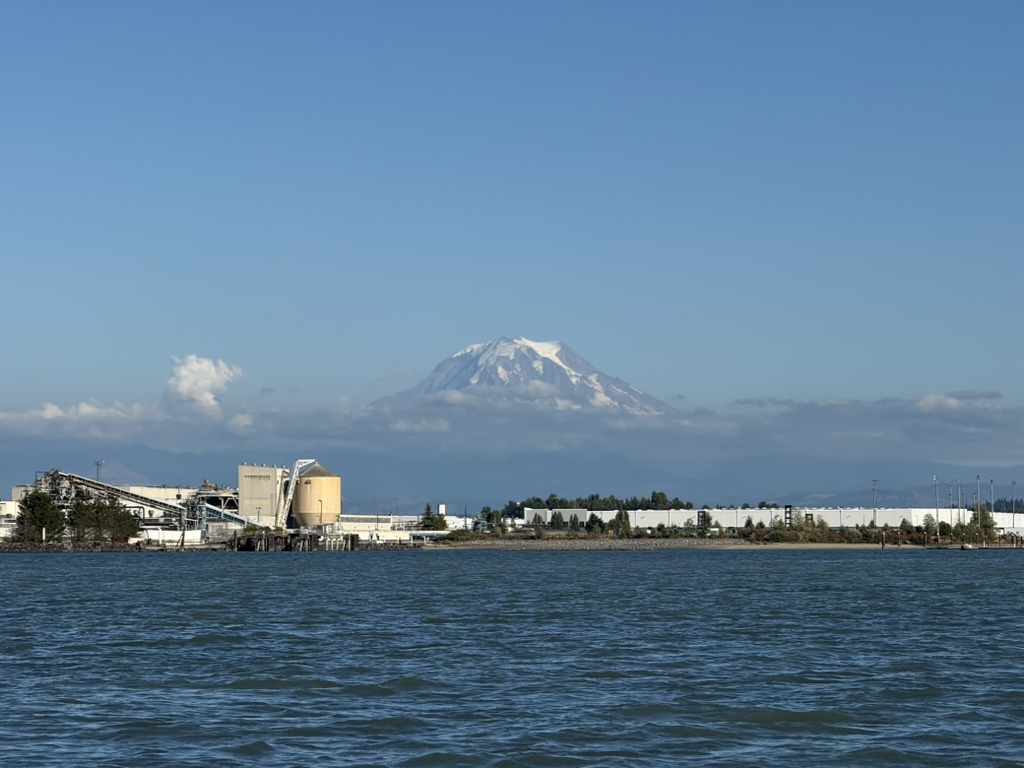
After the rounding, we had a few minor hiccups getting the spinnaker up, but we managed—and just in time to hit a bit of a wind hole. Thankfully, the entire fleet got stuck there too. We were lucky and managed to punch out of it quickly, heading back toward the center of the Sound. What followed was one of the most glorious spinnaker runs I’ve ever experienced. The reach back to West Point was fast, steady, and exhilarating. At one point, we hit 9.5 knots—far beyond what I expected on such a mild, sunny day. The whole run was smooth, with no need to jibe. We just flew downwind with Rainier beckoning on the horizon.
Final Leg to the Finish
We slightly overshot West Point (oops!) but adjusted quickly, dropped the chute, and transitioned to headsails. It took about 20 minutes to sail the final stretch back to the finish. We crossed the line ahead of much of our competition, though at the time we had no idea how we had placed. After putting the boat away, we grabbed lunch, still buzzing from what felt like a nearly flawless day. The entire race had taken us only about two and a half hours to cover about 11-12 nautical miles.
A Surprising Finish
What made it even more extraordinary was that we raced with only three people onboard, including me. Thankfully, the course didn’t require many complex maneuvers, and we managed just fine.
Later that afternoon, I found out we had actually finished first in our class!
All in all, it was a fantastic race, a beautiful day, and a memorable win—proving once again that sometimes, less crew means more fun.




 Blur Racing