
They put the start line for this series about a mile north of Meadow Point. The wind was coming from the south. It was an easy breeze of 6 or 7 knots. The course was a custom course set to go up to the Scatchet Head Bouy off the tip of Whidbey Island, then back down to the Edmonds/Richmond beach area where they had set up a gate which we had to go through on the return to the finish line. Since it was a light air day, we were definitely in our element.
The start was another downwind start. We set ourselves up nicely for it and were ready when the starting horn went off. We crossed the start line right behind Pell Mell, the first place boat in our class, and alongside Mata Hari. We accelerated smoothly past Mata Hari, a much larger boat, and basically followed Pell Mell down the sound toward our first mark at Scatchet head.
As we pulled up alongside Mata Hari, we were chatting with them casually, and then we smoothly accelerated past “Buh bye!” I think civility in racing reflects a certain kind of confidence. If you know you can beat them, then what is the harm in wishing them a nice day? Or perhaps even better, to simply be grateful for the opportunity to be out racing with them on a beautiful day.
Downwind our sail trim looked really good. We (me?) have struggled in the past to make sure that all the little details were taken care of. That the outhaul tension was correct for the conditions: things like having the backstay tension eased and the cunningham tension correct. We’re good at pulling all the big strings (the main sheet, the jib), but we tend to neglect the little strings. This time we were spot on. The whole crew was really on their game. This focus really paid off as the day wore on.
Anna brought the magical wind cookies. They were very tasty home-made chocolate chip cookies made out of buckwheat and, I suspect, mixed with some sort of blood sacrifice to the wind gods. You’ll have to ask Anna for the recipe. For my part, I really don’t need to know all the gory details, just that they taste delicious…and they work!
For the record, wind cookies are ALWAYS welcome.
You see, you need to understand that Pell Mell usually disappears over the horizon very quickly when we race them. She is a similar sized boat to Blur, but owned by a sailmaker, with gorgeous new sails, a professional crew, and well…they’re kinda rock stars. Oh, and she has more sail area. She was sporting a giant masthead spinnaker (OK, so I’ve got spinnaker envy). So 5 miles into the race, you can imagine how happy I was to be running just a 100 yards or so behind Pell Mell! We were actually keeping up with them! We sailed Blur like pros! Bev’s trimming was smooth, Mark was constantly tweaking the rig, keeping a tactical eye to weather, and pushing us to talk more. Anna made every gybe look effortless. And perhaps most importantly, we had the wind cookies. I don’t think Pell Mell had any cookies.
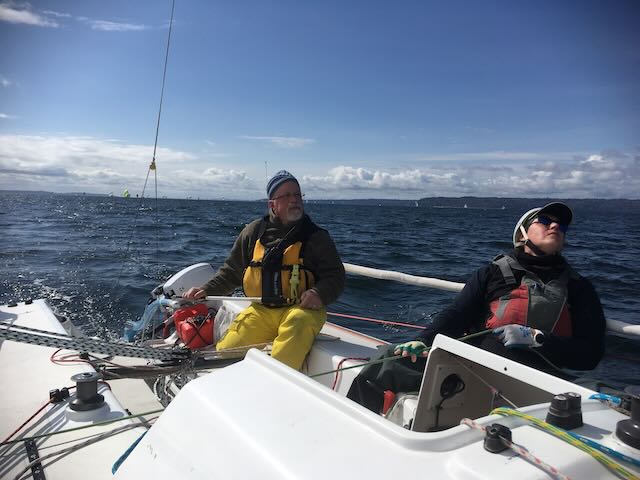
This is the day we found our downwind magic number. What is the magic number? Apparently, in 7-9 knots of breeze, the magic number is 6. That’s 6 knots of boat speed. In the 7-9 knot wind range, keeping our boat speed above 6 knots is pretty fast for us. That means heating up our sailing angles to something more akin to a sprit boat (like a J/80). Having the instruments that read our boat speed and wind angle is turning out to be super helpful. Now we can attach a number to the feeling of, “Hey, that feels kinda fast!” I’m also coming to realize that the 6 knot number can be associated with a specific wind angle in a specific wind range. This is nothing revolutionary – it’s really sailing 101, but with our wind instruments I can start sailing to a specific apparent wind angle downwind that corresponds to our target speed. That’s pretty cool.
Of course looking at all these fancy instruments means that the guy driving the boat isn’t watching where he’s driving. That’s where Mark played a critical role in this race. He was basically operating as our tactician. He was looking at where we were on the course, where the other boats were in relation to us, and where he thought we should go. Then he was conveying that information to the rest of the crew.
When we are racing downwind, the driver has their eyes glued on the speed instruments. The spinnaker trimmer is staring, almost mesmerized, at the spinnaker. So who is watching where we are going? Best case? Everyone else. In this case it was Mark and Anna. Mark and Anna were keeping a wary eye out for obstacles in the water, “Hey! Look out for that log!”
For our entire trip downwind, nearly 10 miles, we had the current behind us. It was about a 1 knot push, so we made really good time. That particular run was probably our best downwind performance ever. Everything about it felt good. The wind was gradually increasing (as forecast), so by the time we reached the southern tip of Whidbey the wind was blowing about 10-12 knots.
As we approached the leeward mark at the Scatchet Head buoy, the boats behind us started to converge. We found ourselves on an intersecting path with Cherokee, the second place boat in our class. Mark asked me if we should wave them across. Now, normally, I wouldn’t have thought of communicating with another boat like that. I don’t think that many folks do. But, unlike cars, sailboats don’t have turn signals. There’s literally no way to know what someone else intends to do out on the water without waving your hands and perhaps hollering at them (also known as “hailing” them). The alternative is to not say anything, scrunch down in your seat, and perhaps mumble, “Ramming speed!” Under your breath as you bear down on your innocent victims. Or you demand the right of way and use the rules of the road as a weapon (which was definitely an option). I want to point out that this sort of non-communication happens more frequently than one might expect.
So imagine my surprise when Mark asks, “Do we mess with them or wave them through?” Now I knew that we could ruin their day by claiming the right of way. But even with that malicious thought, I also knew that they were still likely to beat us upwind (their boat is an upwind monster). So, aside from creating some in-the-moment panic, we weren’t likely to change the outcome of the race by insisting on the right of way. So we opted to wave them through. You could feel their relief from a distance – they also knew that we could have chosen differently. So, it was with a certain amount of gratitude that we were able pass by each other with a wave and a “Good Day!” I have Mark to thank for reminding me of what civility in sailing looks like.
We had a choice as we rounded the mark and headed back upwind toward the finish. Go to the West, and follow the shore up to Kingston, or go East, toward Edmonds and the Point Wells Tank Farm. We decided to go East. Pretty much the rest of the fleet went West. Now we knew that upwind we were now sailing against the current (remember that 1 knot current I mentioned?). So, our intent was to try to get to the shore and stay out of the current as much as possible. However, we were puzzled to see our competition go to the opposite shore. What did they know that we didn’t? We were feeling pretty good. The wind was holding steady, and Blur was sailing upwind pretty well. We were feeling pretty fresh, so why not keep doing our thing? So that’s what we did. It turned out that we were sailing really fast the wrong way.
Splitting from your competition like we did is sometimes referred to in sailing circles as, “Taking a flyer.” It works well if you see something that everybody else misses. It is usually used as a last ditch maneuver to outsmart the competition. Sort of a “Hail Mary” move to try and win the race. However, taking a flyer is also almost universally acknowledged as a low percentage tactical move. A desperation shot. Most of the time it doesn’t pay off. The tactical consensus is generally that the wise move is to stay close to your competition and avoid big separations. I’m not sure that we consciously intended to, but we broke this rule.
Apparently, all the locals know that when the tide is changing near Scatchet Head, one should always go west because there is an eddy in the current on the west side of Puget Sound that gives you an additional 2 knot positive push! This is exactly what our competition was doing. Meanwhile, on the east side of the sound, we were fighting a -1 knot negative current! Over a couple hours of upwind sailing, that can mean a lot of distance. In theory, we gave our competition nearly 3 knots of advantage. Yikes! Of course, we knew none of this at the time.
We continued to sail well, but the current was unforgiving. When we reached the Point Wells Tank Farm there was a gate mark that the whole fleet had to cross. As we all converged, it was apparent that we had lost some ground by sticking with the east shore. I was starting to get pretty tired by that point in the race. In fact, I almost missed the gate, causing a nearby J/105 some alarm, “What the hell is that guy doing?” Fortunately, I snapped out of my funk, and we made it through. Barely.
I really should have traded off the driving with someone else at that point. The wind had continued to build, so we were pounding upwind in the final few miles to the finish. The current had switched direction, and the wind was now blowing against the current. This was creating short choppy waves, which are hard to sail against in Blur and rather exhausting to drive through. The conditions out on the sound were starting to get pretty lumpy. Blur is so lightweight, that getting slapped in the bow by a wave will slow her down considerably. So our progress toward the finish felt a bit tortuous. As we would crash into the waves we took a lot of water over the bow – right into the crew’s faces. People were starting to get really wet and cold. To add to that, I was starting to hear an alarming rattling noise come from the rudder as we bashed through the bigger waves. I’m not sure what was going on there, but it was unnerving at the time.
To our collective and considerable relief, we crossed the finish line around 4:00 and we took third place in our class! It was an outstanding race overall. With this finish, we also took 3rd place for the overall series! This was an excellent start to the sailing season.
 Blur Racing
Leave a comment